by Nomad
Between Words and Deeds
Here’s a case in point. As far as back as 1983, people were beginning to whisper about the fashion sense of Emperor Ronald. In an interesting interview by Frank Browning of Mother Jones Magazine, NBC reporter Tom Brokaw said with admirable bluntness,
President Dwight Eisenhower on January 17 1961 delivered his famous farewell address to the nation. In it, he warned the American people of the dangers of the unregulated growth of the military industrial complex
.


| Facts are stubborn things. -Ronald Reagan |
 |
| Marketing the Pitch |
If Ronald Reagan hadn’t existed, then the neo-conservatives would have had to invent him. In some respects, that’s exactly what they did. It seems sadly ironic that Reagan is more valuable as a myth to the Republican party than when he was a living president. He has allowed them to hold on to a very useful fantasy. Moreover, he has been used time and time again to justify inexcusably outrageous tax cuts for the minority of the population that clearly needs them the least. Besides, it would highly embarrassing to have the real Reagan contradicting his own myth-makers and exposing them as hypocrites and frauds.
Still, for anybody who actually lived during the Reagan years and paid any attention whatsoever, the repeated make-overs, the erasures and exaggerations can be irritating, astounding and, at times, just plain amusing.
 |
| Brokaw: Hiding the lies |
I thought from the outset that his "supply side" theory was just a disaster. I knew of no one who felt that it was going to work, outside of a small collection of zealots in Washington and at USC (The University of Southern California) Arthur Laffer, Jack Kemp. What I thought was quite outrageous was that the business community which for years had carped and complained that it could never get a president sympathetic to its needs, finally got its champion, Ronald Reagan. Then, to its horror, it discovered that he was actually going to press ahead with supply side- a theory who disastrous consequences businesspeople began to prepare for, but did not publicly warn the rest of the country about. They knew it simply could not work. But they did was look to their own little life raft and not to anyone else's.
Browning asked Brokaw what made Reagan special in terms of his relationship with Big Business. Haven't all presidents in the last 30 years, he asked, been sympathetic to big business? Brokaw responded:
Big Business has more access to him. There's less to offset big business' influence on Ronald Reagan from a political point of view, than there has been on any other president in the past. Even Richard Nixon has a stronger sense of what was politically possible and what was not.
The interviewer then turns the tables on Brokaw.
Browning: As we sit here talking, your comments on Reagan, the Corporate President, are sharp and incisive. Yet when you covered the same territory on television, in the midterm special, it all seem like so much mishmash. The points were diffuse and it felt superficial.
Why didn't he speak so courageously on the air, when it counted? the writer asks. Brokaw tried to dodge the question by discussing the same point made in a cartoon. (That all-of-us-are-to-blame defense.) Finally, he lamely admitted, "I suppose your point is well-taken."
Browning: You just criticized members of the business community for keeping their mouth shut even though they knew Reagan's ideas were idiotic.
Brokaw: Right.Browning: Now I suppose you can't say the president is an idiot on national television. But aren't you guilty of the same thing?Brokaw: You would have been happier if I had just said. "Maybe the business community will finally have the courage to tell this guy to his face that his program is not working."Browning: That would have been a lot straighter.Brokaw: But part of what governs our thinking is the whole business of "Is it balanced? Is this a fair and balanced program? The Washington Post said our program was quite tough on the president. I thought it was a fair report on what people are saying."
Basically he is rationalizing that unbiased reporting was more important than simply telling the truth. Brokaw unconvincingly attempts to hide behind phony insecurities of fairness (using that now-dreadful phrase “fair and balanced”). This has become the excuse de jour for all mainstream media, as if being balanced permits a journalist to hide the truth.
Yet, there’s more than meets the eye in the interview. The thing that Brokaw fell just short of saying, but the point that the interviewer successfully exposed is that when it came to revealing to American public the truth about Reagan and his economic plan, Tom Brokaw had become just as much of a deceiver as big business. Perhaps his guilt was even greater since it was specifically his job to inform the public- not big business. Still, what even the Mother Jones interviewer naively failed to note was that Brokaw, as a top reporter for NBC, was little more than a hired spokesperson for the very same corporations he had just hypocritically derided.
One may or may not forgive Brokaw’s past shortcomings but how can one excuse the same hypocrisy to a new naive generation? In February of 2011, now “legendary” Tom Brokaw found himself at the Ronald Reagan Presidential Library, moderating a two-day discussion panel on the legacy of Ronald Reagan before a crowd of more than 500 students, scholars and Reagan admirers.
Yet, there’s more than meets the eye in the interview. The thing that Brokaw fell just short of saying, but the point that the interviewer successfully exposed is that when it came to revealing to American public the truth about Reagan and his economic plan, Tom Brokaw had become just as much of a deceiver as big business. Perhaps his guilt was even greater since it was specifically his job to inform the public- not big business. Still, what even the Mother Jones interviewer naively failed to note was that Brokaw, as a top reporter for NBC, was little more than a hired spokesperson for the very same corporations he had just hypocritically derided.
 |
| Brokaw: Promoting the legend |
"A pure product of Main Street, Heartland America. He even looked the part,” he told the audience,”"People were comfortable with him from the very beginning."
Terms like "product" and "looking the part" are hidden messages lost on the adoring crowd. The underlying message is public relations- the bastard son of leadership. Meanwhile, other speakers took up the usual Reagan refrains, slipping into the well-trodden land of Reagan fantasyland. As another speaker said..
"Ronald Reagan was a great president, and he will be remembered in history for one thing, winning the Cold War," exclaimed Reagan biographer Lou Cannon to a standing room only crowd.
The ironies do not stop there. The event was organized by various partnering foundations at the USC- that’s correct, at the University of Southern California- the very spot Brokaw sneered at in 1983 as being a hangout of Reagan zealots.
Proving that truth sometimes spills out even in the most unlikely and unpromising situations, another speaker, Richard Reeves, author of "The Last Campaign: Legacy," an academic paper prepared for the symposium, astutely noted:
"Reagan was not a great president but was great at being president.... He understood that words were often more important than deeds for the leader of a sprawling and diverse nation..”
So much could be read into a statement like that and yet, so few people seem to have the courage (or perhaps the integrity) to come right out and say what the historical evidence clearly proves. Even now, among certain quarters, the truth must be left to cryptic blurbs and subtle remarks.
Columnist Matt Lewis notes, General Electric, the 6th largest firm in the U.S, as well as the 14th most profitable, ran ads honoring the 40th president's legacy --and donated $10 million to the Ronald Reagan Presidential Foundation and Library, along with additional $5 million in scholarships. Even though they could never admit it, historical research reveals that General Electric owes Ronald Reagan a lot more than that "chicken feed."
Reagan and the General Electric Theater
Columnist Matt Lewis notes, General Electric, the 6th largest firm in the U.S, as well as the 14th most profitable, ran ads honoring the 40th president's legacy --and donated $10 million to the Ronald Reagan Presidential Foundation and Library, along with additional $5 million in scholarships. Even though they could never admit it, historical research reveals that General Electric owes Ronald Reagan a lot more than that "chicken feed."
Reagan and the General Electric Theater
It should surprise nobody that NBC Nightly News anchor Brokaw would have been a tad reluctant to expose Reagan. After all, General Electric, the 10th largest corporation in the United States owned NBC Nightly News. It was also a major defense contractor and an international player on the world market. Brokaw knew what most people who work for large corporations understand without being told: There are things you should and should not do.
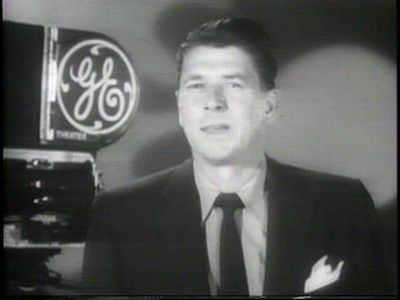
Reagan had worked for GE before his political career. It was a lucrative relationship. He had worked eight years as host (and part owner) of GE Theater, a popular TV show starting September 26, 1954 and ending May 27, 1962. Wikipedia tells us:
...Reagan estimated he had visited 135 GE research and manufacturing facilities, and met over a quarter-million people. During that time he would also speak at other forums such as Rotary clubs and Mooselodges, presenting views on economic progress that in form and content were often similar to what he said in introductions, segues and closing comments on the show as a spokesman for GE.
Over time, Reagan was becoming increasingly political. According to Reagan biographer Michael Schaller,
Year in and year out, in speeches he wrote himself, Reagan warned audiences about the perils of big government, creeping regulation and communism. Corporate leaders, he argued, defended American freedom, depsite the burden of high taxes, impediments to the free market and other anti-business measure imposed by Democrats.
The love affair between GE and Reagan ended suddenly, according to biography notes. Reagan was dismissed in response to his reference to the TVA as one of the problems of "big government." That's the official story. (Ratings for the show had also been declining.) During this time, Reagan seems to have undergone a kind of political grooming -with the kind assistance of GE. According to GE website:
At the time, GE published four publications and all were required reading for the president. These newsletters and magazines covered topics ranging from government and the economy, to company bowling results. Reagan used the material to communicate more effectively when giving speeches and talking informally to thousands of GE factory workers.Train travel and chauffeured car trips to company plants, allowed him to read the economic texts of writers Henry Hazlitt and Louis Haney and immerse himself in Sun Tzu’s “Art of War” and Friedrich Hayek’s economic and political writing. Both Hazlitt and Haney were especially influential in shaping Reagan’s views on deficit spending. From an article in “The Forum” (A GE defense quarterly) came the seeds for the Strategic Defense Initiative.
Eventually, Democrat GE spokesperson Reagan would transform, like a political butterfly, into Republican candidate Ronald Reagan. So this sudden break, GE's decision to fire Reagan because of his outspoken political views, was it all just a bit of theater on General Electric's part?
.
In the councils of government, we must guard against the acquisition of unwarranted influence, whether sought or unsought, by the military-industrial complex. The potential for the disastrous rise of misplaced power exists and will persist.Just over a year later, Ronald Reagan's political career began. Once president, Reagan oversaw the largest peace-time military build-up in history, leaving GE millions of dollars richer. That was just the beginning.
We must never let the weight of this combination endanger our liberties or democratic processes. We should take nothing for granted. Only an alert and knowledgeable citizenry can compel the proper meshing of the huge industrial and military machinery of defense with our peaceful methods and goals, so that security and liberty may prosper together.
According to a report by Boston-based INFACT, GE's nuclear weapons prime contract awards increased threefold during the Reagan years-- from $2.2 billion in 1980 to $6.8 billion in 1986. GE's 1988 annual report cites aerospace as one of the big growth areas in its operations. Much of its income in this field derives from government contracts. The report notes that GE revenues for aerospace operations were 22 percent higher in 1987 over 1986, increasing from $4.3 billion to $5.2 billion. There was also the B-1 bomber program in 1981 represented one of GE's most lucrative contracts, in spite of the fact that the bomber has long been discredited as a viable or necessary weapon.
Hold on.. there's one more piece to the puzzle. The hardest part to swallow perhaps. The biggest shame of the Trickle Down lie.
As Reagan second and final term wound down to a depressing end- plagued with scandal and questions about Reagan's fitness for office, GE Chief Executive Officer, Jack Welch was launching a new direction for the company, earning his the nickname "Neutron Jack" because, like the Neutron Bomb, he left factories standing but decimated the workers. In Jack: Straight From The Gut, Welch states that GE had 411,000 employees at the end of 1980, and 299,000 at the end of 1985.
Writer John Summa gives this excellent account:
As GE's operating profits swelled..., its total workforce in the U.S. was cut by over 100,000, with more layoffs and plant shutdowns to come. GE has a "decidedly consistent policy to drive down labor costs worldwide," according to Peter Gilmore, director of public relations for the United Electrical, Radio and Machine Workers of America (UE), a union representing many of GE's U.S. workers.In addition to transferring jobs to Third World plants owned by the parent company, Gilmore says GE has been cited by Singapore union officials for shifting production from Singapore to Malaysia. There is evidence of "state, regional and international-level whipsawing" by GE, he says. Whipsawing refers to the attempt to play one workforce off against another, or others, in order to force greater concessions. Not only is GE shifting production from the U.S. to the Third World, it is also exploiting wage differentials in the Third World itself."There has been a tremendous reduction in the U.S. workforce in the last couple of years," says Gilmore, "especially since Welch took over in 1982." The work currently being done at GE's Juarez maquilladora plant in Mexico, he says, used to be done at the Decatur, Indiana plant. Gilmore adds that the Decatur workforce has a reputation for high productivity, flexibility and capability to implement prototypes.
And when Welch retired in 2001 with a net worth estimated at $720 million, one editorial gave this critique of his career at GE:
Welch has left behind communities across the United States suffering from mass layoffs and disinvestment. While it is hard to get a fix on the number of GE layoffs over the last two decades because of the constant churning of its businesses, GE has dismissed well over 100,000 well-paid workers in the United States. It has undermined union power in the United States by shifting operations to non-union subcontractors. It has practically abandoned its once-strong research-and-development infrastructure. It has compiled a shoddy record of repeat violations of workplace safety rules, defense contractor safeguards, and other public interest regulations, with workers’ lives put at risk and taxpayers bilked as result.
This is the true legacy of the Reagan revolution. Perhaps this is what it has always been about.
David Stockman's supply side economics-with its necessary reduction in military spending- was destined to be wrecked because, whether he knew it or not, Reagan was merely a carefully manufactured defense contractor spokesman. The real power holders, meanwhile, were already embarking on a plan to disengage from expensive American labor, effectively forcing the American worker to compete against the non-unionized Third World labor.
Orthodoxy and Heresy
Even a casual mention of it brings inspired tears to the eyes of Reagan lovers and unleashes lavish praise on his memory. To steal a line from Shelley,
His name is Reagan, king of kings,Look on his works, ye Mighty and despair!”
The economy did get better, they’ll tell you, you can’t deny that. Kevin Drum, writing for Mother Jones wearily attempts to rebut the orthodoxy that has become the rallying cry of every conservative Republican.
It's probably hopeless to take on the Reagan economic myth at this late date, but honestly, it's long past time to put it to rest. The truth about the '80s is far more prosaic: In 1979, Jimmy Carter appointed Paul Volcker chairman of the Federal Reserve. Inflation was running at about 12 percent when he took office, and Volcker immediately slammed on the monetary brakes in order to bring it down. Whether he was targeting interest rates or monetary aggregates remains a bit murky, but it hardly matters. In the end, he engineered one minor recession in 1980, and when that didn't do the trick, he tightened Fed policy even more and threw the economy into a second recession—this one extraordinarily deep and painful—which he maintained until 1982. When he let up, the economy recovered. Reagan had very little to do with it.
That’s the kind of heresy that makes a freedom-loving Reagan myth believers’ blood boil. Carter? The worst president ever? Not him, they’ll tell you. Drum, however, persists:
But that's not all. If you're looking for other reasons that the 1980s were boom years, No. 2 would be oil prices. The American economy is highly sensitive to oil prices, and after peaking at around $100 per barrel during the Iranian revolution (in inflation adjusted terms), oil prices steadily dropped, falling below $30 in 1986 (again, in inflation adjusted terms). This was largely due to
(a) reduced demand thanks to the recession;
(b) reduced demand thanks to CAFE (The Corporate Average Fuel Economy) standards and other conservation/efficiency improvements that followed the oil shocks of the '70s;
(c) increased oil supply from Prudhoe Bay, which peaked in the early '80s; and
(d) increased oil supply thanks to a Jimmy Carter executive order ending price controls on oil.
Again, Ronald Reagan had very little to do with it.
And guess who agrees with that assessment? None other than the original whiz kid, David Stockman, Reagan’s unhappy budget director.
But when, in the following years, the Federal Reserve chairman, Paul Volcker, finally crushed inflation, enabling a solid economic rebound, the new tax-cutters not only claimed victory for their supply-side strategy but hooked Republicans for good on the delusion that the economy will outgrow the deficit if plied with enough tax cuts.
And the problem with tax cuts is that, while decidedly popular with the electorate, (who doesn't want free money? And, as they say, it's OUR money anyway!) without spending cuts, these tax cuts inevitably lead to enormous debt . Add a blank check for an unnecessary two-front war, throw in astronomical oil prices, ladle in a few dollops of overcharging by no-bid contractors.. and the results were as predictable as they were disastrous.
Economist Paul Krugman, Professor of Economics and International Affairs at the Woodrow Wilson School of Public and International Affairs at Princeton University, Centenary Professor at the London School of Economics, also takes on the dogma:
…(T)he claim, quite common on the right, that the US economy was stagnant until Reagan did away with those nasty New Deal policies — a claim that is simply, flatly, false. The era of strong unions, high minimum wages, high top marginal tax rates, etc. was also a period of rapid growth and rising living standards. That doesn’t prove causation; it does disprove the widespread dogma that these things are always economically devastating. And it’s telling that so many on the right have airbrushed the whole postwar generation out of history,
Airbrushing Ronald Reagan has become a full time job and for authors who place writing a bestseller over writing an honest history, it has become a career in itself. The legacy of Ronald Reagan is permenantly under construction, with new additions to the myth being added by plutocrats, hack journalists, but especially by Republican candidates looking to add a little false glory to their pathetic lack of leadership.
The Current Mess
Journalist Will Bunch, a senior writer for the Philadelphia Daily News and author of Tear Down This Myth: The Right-Wing Distortion of the Reagan Legacy, Bunch argues that the Reagan legacy was created largely by Washington conservatives in the 1990s, who wanted a hero who they could associate with the conservative agenda.
It's been very hard for the modern generation of Republicans to develop a leader... who has the kind of charisma that Ronald Reagan has had.” In the absence of that charisma, the next generation decided to "borrow it" from the past.
Borrow is a mighty charitable word when “dream it up” and "hijack" are so much more accurate.
Sometimes it’s hard to know precisely whether the sycophantic Reagan devotees actually believe the myth or whether it merely suits their purposes. Despite all evidence to the contrary, the GOP candidates seemed determine to continue regurgitating the same Reagan nonsense. However, like a lot of the fallacies about Reagan, there is a major difference between what occurred on his watch and what he was actually responsible for. It’s something that so many die-hard Republicans fail to grasp, no matter how much you try to explain. No, Reagan did NOT bring down the Soviet Union. He was only president when it occurred. No, Reagan did not create the economic miracle, he just happened to witness it and took the credit for it.
It works to the advantage of the 1% to promote such nonsense and it has been proven- at least, up to the moment- that repeatedly uttering Reagan's name does tend to hypnotize conservative, especially Tea Party, voters. (Clinically it's not really hypnotism. More akin to tonic immobility- a natural state of paralysis that animals enter, in most cases when presented with a threat.)
If this re-writing of the Reagan history seems like childish nonsense, then just listen to presidential candidates.
Mitt Romney, ever the flip-flopper, really can not decide how he stands on Reagan. He isn't a Reagan fan but then he is. Then again, who knows? It's hard to name any issue that Romney is 100% firm about.
When Rick Perry was confronted with facts, on the usually fact-deprived stage of Fox News, he once again pulled out the trickle-down hand puppet.
(Perry) told Fox News Sunday host Chris Wallace this morning that his 20 percent optional flat tax plan would help “job creators” create 2.5 million new jobs in America. When Wallace noted that high-income Americans would benefit the most from Perry’s plan, the governor responded that “they’ll invest in companies and create jobs.”He also dismissed Wallace’s assertion that “even conservative think tanks” believe that Perry’s economic proposal would massively increase federal deficits. But he took his plan’s projected loss of $4.7 trillion in federal revenue over six years (that’s his campaign’s projection) as a badge of honor.“There’s nothing wrong with lower revenue,” he said.
This is a man that wishes to be president? Is this what the bottom of the barrel looks like? No, THIS is what the bottom looks like.
Presidential candidate Michele Bachmann likes to promote that same illegitimate imaginary myth about the Reagan revolution, presumably basing her enthusiasm on solely faith or fantasy. It's very doubtful she actually understands what she is says.
“We had an economic miracle in the 1980s under Ronald Reagan and I want to bring those positive solutions into the tax code and get rid of the current mess that we have and put in a living laboratory of what worked in the 1980s.”
Here's Sarah Palin- the woman who is not running- putting Reagan name-dropping to its supreme test in just another effort to get herself some undeserved attention. Like a lot of things she does, she carries it too far, to the very edge of parody. Palin invokes Reagan's name so often and so unnecessarily that she threatens to reduce the whole technique to burlesque. No wonder the GOP finally had to warn her.
It is highly doubtful whether a resuscitated Reagan would ever approve of the way his name has been used to absolve the profligacy of the neo-conservatives of this day and age. Sadly we have no way of knowing what Reagan himself might think of the contorted path the Neo-conservatives have taken the country down. We do, however, have the supply side economists to turn to.
Hindsights of the Economists
Interestingly, the early advocates of “supply side economics” are the ones who are now most vociferous in their criticisms of the present day GOP. Surprisingly perhaps, Dave Stockman turns out to be the most strenuous critic of what he sees as a misrepresentation of the Reagan policy, misrepresentations by the Republicans leaders. He doesn’t mince his words in his condemnations. In an op-ed piece for the New York Times in 2010, Stockman states:
If there were such a thing as Chapter 11 for politicians, the Republican push to extend the unaffordable Bush tax cuts would amount to a bankruptcy filing. The nation’s public debt — if honestly reckoned to include municipal bonds and the $7 trillion of new deficits baked into the cake through 2015 — will soon reach $18 trillion. That’s a Greece-scale 120 percent of gross domestic product, and fairly screams out for austerity and sacrifice. It is therefore unseemly for the Senate minority leader, Mitch McConnell, to insist that the nation’s wealthiest taxpayers be spared even a three-percentage-point rate increase.
Ouch! But.. but Mitch sounds so believable! Stockman, who was once so naive, now holds back none of his venom:
Republicans used to believe that prosperity depended upon the regular balancing of accounts — in government, in international trade, on the ledgers of central banks and in the financial affairs of private households and businesses, too. But the new catechism, as practiced by Republican policymakers for decades now, has amounted to little more than money printing and deficit finance — vulgar Keynesianism robed in the ideological vestments of the prosperous classes.
According to Stockman, the neo-conservatives in the Republican party are little more than traitors to the party.
This approach has not simply made a mockery of traditional party ideals. It has also led to the serial financial bubbles and Wall Street depredations that have crippled our economy. More specifically, the new policy doctrines have caused four great deformations of the national economy, and modern Republicans have turned a blind eye to each one.
Perhaps Stockman needs to read up on Bryan. Being extraordinarily kind and accommodating to the wealthy class has always been a traditional Republican party ideal. Between the two parties, Stockman does find most fault with the Republicans.
This debt explosion has resulted not from big spending by the Democrats, but instead the Republican Party’s embrace, about three decades ago, of the insidious doctrine that deficits don’t matter if they result from tax cuts.In 1981, traditional Republicans supported tax cuts, matched by spending cuts, to offset the way inflation was pushing many taxpayers into higher brackets and to spur investment. The Reagan administration’s hastily prepared fiscal blueprint, however, was no match for the primordial forces — the welfare state and the warfare state — that drive the federal spending machine.
This was pretty much- sorry, exactly- what Stockman had revealed in The Atlantic article back in 1981.
There’s was never really any Reaganomics. No real world application of supply-side. The real world never allowed it. Between the two favorite millstones of both the Democratic and Republican party, the possibility of ever having a balanced budget was quite impossible.
Dr. Paul Craig Roberts, considered by many to be the father of Reaganomics, appears to think that the present species of neo-conservatives, though they regularly use Reagan’s image, a have very little real ideological connection to the man. In his opinion, the neo-cons, particularly the ones that emerged in the George W. Bush’s administration, have effectively hijacked the Reagan revolution for their own purposes. Prepare yourself to gasp. Roberts claims:
Reagan was certainly no neoconservative. He went along with some of their schemes, but when neoconservatives went too far, he fired them. George W. Bush promotes them.
Reagan wasn't a neo-conservative? Hmmmm, try telling that to Fox News.
We have reached a point where the Bush administration is determined to totally eclipse the people. Bewitched by neoconservatives and lustful for power, the Bush administration and the Republican Party are aligning themselves firmly against the American people. Their first victims, of course, were the true conservatives.
Roberts still defends “supply-side” theory and the benefits it delivered. Failing to understand precisely how his ideas were used to serve a larger purpose, he still seems awfully naive when he defiantly states:
Supply-side economics made good on its promise, and Ronald Reagan delivered both the longest peacetime U.S. expansion and disinflation. This achievement has been buried under a pack of lies told by people whose reputations exceed what their integrity warrants. They succeeded in their goal of pushing the Bush Administration away from successful policies and toward self-destruction.
Not everyone was so impressed with the Reagan recovery. As Dinesh D'Souza, a former policy analyst in the Reagan White House, writing for Forbes Magazine back in 1997 points out,
During the recession of 1982 the poverty rate rose from 12% to 15%. Unemployment climbed sharply, from 7% to nearly 11%, which meant that 10 million Americans were out of work. High unemployment rates were due not just to the economic slowdown but also to larger changes in the economy. Foreign competition was forcing American companies to downsize and become more competitive.
Strikingly, despite the debate between the father and the whiz-kid, they are in agreement that the Republican neo-conservative movement of today has misused the economic and political philosophies espoused Reagan (if not actually applied) in order to create something Reagan himself would probably not recognize nor approve.
Our present time, with the Republican party defying the will of the majority, the top tax bracket, the super wealthy are attempting to use every possible means to retain their wealth, even as the national economy sinks
As William Jennings Bryan once said only a hundred years ago:
Against us are arrayed a comparatively small but politically and financially powerful number who really profit by Republican policies; but with them are associated a large number who, because of their attachment to their party name, are giving their support to doctrines antagonistic to the former teachings of their own party.
Amazing how some things never change. Except, now, of course, we have the nightly brainwashing by the Fox News propagandists telling how unfair it is to even think about asking the top 1 % to forgo their generous Bush tax cuts. The script writers at Fox have double-downed efforts to paint Obama as some kind of socialist, communist, anarchist- anything but a realist. Why? Simply because Obama is demanding from those who have profited so much by this elaborate con game to pay some back before the whole country is reduced to poverty. So Hannity can be found nightly whining, "Where is our prosperity supposed to trickle down from?" O'Reilly pretends to be outraged and blusters: "How dare Obama ask them to pay their fair share. Why it's class warfare!"
To that, Bryan delivers this bit of advice.
To that, Bryan delivers this bit of advice.
No one has a right to expect from society more than a fair compensation for the services which he renders to society, if he secures more it is at the expense of some one else. It is no injustice to him to prevent his doing injustice to another.Hear, hear, Mr. Bryan. Now let's tell that to the 1%.
-------------------------------
Please Be sweet and retweet:
http://twitter.com/#!/ANomadicView/status/150307629351174144
http://twitter.com/#!/ANomadicView/status/150308700815503360
Digg
http://digg.com/news/politics/the_fallacy_of_reaganomics_3_3_politicalgates
Parts 1 The Fallacy of Reaganomics
Part 2 -The Fallacy of Reaganomics
Please Be sweet and retweet:
http://twitter.com/#!/ANomadicView/status/150307629351174144
http://twitter.com/#!/ANomadicView/status/150308700815503360
Digg
http://digg.com/news/politics/the_fallacy_of_reaganomics_3_3_politicalgates
Parts 1 The Fallacy of Reaganomics
Part 2 -The Fallacy of Reaganomics