Showing posts with label conservative politics. Show all posts

Monday, February 13, 2012

The Sudden Death of the Living Wage: ACORN 3/3


by Nomad


In the previous posts, we have looked into the meaning and importance of the living wage movement. We have also examined both the Conservative argument against and the history of the movement. In the final part of this three part series, we will examine at the more recent attempts at establishing a living wage and the organization that was destined to achieve some impressive results.

The Rebirth of the Movement
One organization took up the cause of campaigning for a living wage and throughout the 1990s, won unprecedented successes. It was called “the nation's largest community organization of low- and moderate-income families, working together for social justice and stronger communities" with the name the Association of Community Organizations for Reform Now, better known as ACORN.
Ilyse Hogue, writing for The Nation, gives this summary about the important role that ACORN played. 
ACORN was unique as an organization that served our nation’s poor people. Wrangling with life’s common challenges like mortgages and housing forms, ACORN employees built trust by offering help person to person, neighborhood by neighborhood. They then leveraged that trust to lobby for federal legislation to address the root causes of the crises facing these people—predatory lending, lack of community investment and stagnant wages.
As mentioned earlier, critics of the living wage movement would like to propagate the easily-refutable notion that the living wage movement is a relatively recent political phenomenon. That much is true only as it pertained to ACORN's involvement. As John Atlas, president of the National Housing Institute and author of Seeds of Change, puts it:
Acorn spearheaded campaigns to adopt living-wage laws in dozens of cities and increase state minimum wages, resulting in millions of Americans getting raises. Its free tax counseling has helped make the federal earned-income tax credit an effective antipoverty program.
ACORN took up the cause of the living wage after witnessing the achievements of another, smaller organization in Baltimore which successfully campaigned for a living wage. Baltimoreans United in Leadership Development (BUILD), an alliance between a labor union and religious leaders in Baltimore, launched a successful campaign, convincing Baltimore city officials to enact a living wage requirement for employees of contracted businesses working with the city.
According to the book, Fight for a Living Wage, by Stephanie Luce, Associate Professor at the Murphy Institute, City University of New York:
Workers in some of Baltimore's homeless shelters and soup kitchens had noticed something new and troubling about many of the visitors coming in for meals and shelter: they happened to have full-time jobs. In response, local religious leaders successfully persuaded the City Council to raise the base pay for city contract workers to $6.10 an hour from $4.25, the federal minimum at the time. The Baltimore campaign was ostensibly about money.
But to those who thought about it more deeply, it was about the force of particular moral propositions: first, that work should be rewarded, and second, that no one who works full time should have to live in poverty.
ACORN developed similar city ordinance campaigns across the country, fifty cities, such as Boston, Los Angeles, San Francisco, and St. Louis, over twenty colleges and universities, twenty statewide campaigns. At least 140 living wage ordinances in cities throughout the nation were enacted by 2007.
Success like that is certainly an effective way of getting the attention of the Conservative Right Wing.

Blood in the Water
In some ways, ACORN might have been a little too successful and too quickly.
For example, back in 1996, it found itself being hoisted by its own petards when ironically, its California offices actually filed suit to exempt the organization from the state's minimum wage laws - at the time, just $4.25 per hour. After years of battling with businesses and non-profits contractors to pay higher wages, ACORN suddenly found itself using the same excuses for paying its own worker less than minimum wage. 
Interestingly, its lawyers argued that, by paying minimum wages to its staff, it would be limiting its First Amendment right of free speech, since it would have to hire fewer workers and thus, making it harder to get its message out. While conservatives chuckled privately while erupting publicly, others could point out that justice often cuts both ways and there’s no shame in that. If ACORN felt the pressure, that's fine too.

Admittedly, there were some serious management problems at ACORN. With an annual budget of around $25 million- 10% of that coming from federal sources, a smaller figure from state sources, and the rest coming from supporters and membership, greater oversight and accountability were essential. But, unfortunately, that's not what occurred.

Dale Rathke, brother of ACORN founder Wade Rathke, embezzled nearly $1 million. The lost money was recovered and Rathke was removed from the ACORN board but only after the matter became public several years later. (Wade stepped down that same day as ACORN's chief organizer.)
As one defender puts it:
But the misjudgment of a few employees is hardly grounds for withdrawing federal or foundation funds.
As damaging as such revelations are, it’s important to put that in the proper perspective. When military contractor Dyncorp reportedly lost millions of dollars and overcharged the government in Afghanistan, this corporation was rewarded with further lucrative military contracts. When Halliburton lost track of more than $18 million worth of equipment in Iraq, where was the orchestrated outcry? Where was the collective action by Congress to punish the wrong-doers? Instead there was only that all-too- familiar, "a few bad apples" excuse. With failures involving taxpayer’s money in the war-effort, the last Republican administration hardly maintained the standards it demanded of ACORN. 
Nevertheless, the self-inflicted damage to ACORN's reputation had been done. Worse than that, there was blood in the water.

Coup de Grâce 
That ACORN should become a target is hardly a surprise. Given its successes in defending the rights of the low-income, in such matters as predatory bank mortgage practices, voter registration and the campaign to establish a living wage, it was really only a matter of time.
With its superficial connections to candidate Barack Obama, ACORN was bound to become a political football in the 2008 election.
In October 2008, the campaign for Republican presidential candidate John McCain released a Web-based advertisement claiming ACORN was responsible for "massive voter fraud," a point that Sen. McCain repeated in the final presidential debate. Factcheck.org called this claim "breathtakingly inaccurate," but acknowledged that ACORN had problems with phony registrations.
With the insistent noise from Fox News and the plethora of conservative organizations, attempting to point out that “voter registration fraud” is not the same as “voter fraud” was pretty much a waste of breath.

Regardless of their lack of validity, the claims had their effects on public opinion. A subsequent national survey revealed shocking public misperception about ACORN: More than half of Americans have an unfavorable opinion of the organization, and 52 percent of Republicans, 18 percent of Independents, and 9 percent of Democrats think ACORN actually stole the election for Obama.


James O’Keefe III 
With all that disinformation, the clocks were ticking down. The coup de grâce was delivered by activist James O’Keefe III and sidekick, Hannah Gilesposing as a prostitute and a Superfly pimp. In the summer of 2009, videos surfaced which appeared to show low-level ACORN staff members in six cities providing advice on the best ways to get away with tax evasion, human smuggling and child prostitution.
In its defense, ACORN reported that it fired the employees who offered the advice and noted that the conservative activists, who secretly filmed the encounters, were turned away by other ACORN workers. 
As far as the explosive charges that caused so much outrage, there was a lot more to the story. Later it was revealed that O'Keefe had intentionally created a false impression. As MediaMatter.org reports, the unedited versions showed that  O'Keefe often appeared at ACORN offices dressed rather conservatively -- slacks and dress shirt -- when he talked to ACORN staffers, and he often presented himself as a law school student and an aspiring politician trying to rescue his prostitute girlfriend from her abusive pimp. 

Incidentally, O'Keefe was also behind the 2008 scandal with Planned Parenthood where he posed as a caller trying to donate money to specifically fund abortions for African Americans. As unlikely as it sounds, according to O'Keefe, part of his motivation for placing the call was to fight the racism he perceives in Planned Parenthood.

Pulling the Plug
On 17 September 2009, The House of Representatives in a 345-75 vote approved a GOP amendment to a student loan bill that would defund ACORN. The move followed the Census Bureau Director Robert Groves' decision to sever ties with ACORN.
“Recent events concerning several local offices of ACORN have added to the worsening negative perceptions of ACORN and its affiliation with our partnership efforts,” Groves wrote in the letter sent to ACORN President Maude Hurd on Sept. 11.
The House vote was by no means an unanimous decision. Seventy-five  House lawmakers, all Democrat voted to keep giving ACORN federal taxpayer dollars, despite the Groves' decision. 
New York Democratic Rep. Gregory Meeks opposed defunding the controversial group because he needed more evidence that the incidents captured by undercover journalists was, in fact, systemic.
“To me it’s a matter of principle; I don’t know that it’s systemic and I’ve seen what they’ve done to help poor people in the New York area,” Meeks said.
The then-House Speaker Nancy Pelosi condemned the organization but felt the defunding was an extreme reaction. 
“Well, let me say this: any group that receives any funds from the federal government needs to have tough scrutiny applied to it,” Pelosi said at her weekly press conference. “I think it's up to the Appropriations Committee to scrutinize ACORN or any other group that receives money from the federal government that has such an allegation against it.” 
Allegations, a sensational but largely made-up sting operation, non-stop hysteria by Fox News followed by over-reactions in Congress. That was all it took to end all hopes of a living wage for working Americans. 

Consequently, the death of the living wage movement in the US- as sponsored by ACORN- was not a natural one. It was a carefully calculated assassination.
Some foundations also pulled the plug. The Catholic Campaign for Human Development, the United States Conference of Catholic Bishops' anti-poverty charity, praised Acorn for its work "preventing home foreclosures, creating job opportunities, raising wages, addressing crime, and improving education." But under pressure from conservatives, it, too, cut off Acorn's money.
With the Catholic Church’s record of standing for the poor, especially in terms of its historical commitment to a living wage, that decision was inexcusable and cowardly. It went against every thing it had once stood for.

Conservative groups also put pressure on other sources of ACORN funding. For example, the co-founder of The National Legal and Policy Center, Peter Flaherty, wrote to JPMorgan Chase CEO Jamie Dimon demanding an end to any funding of ACORN. According to the 2007 tax return for the JPMorgan Chase Foundation, ACORN Housing, Inc. was the recipient of a million dollar grant in 2007. Another grant of $25,000 was made to the ACORN Institute.  Flaherty's veiled threat is interesting:
Continued identification with ACORN harms the company’s brand name and reputation, and carries special risks for this company, a recipient of taxpayer TARP funds. The New York Times has identified you as President Obama’s “favorite banker.”
Coincidentally, from 1984 to 1988, Mr. Flaherty served as Chairman of the lobbying group Citizens for Reagan. NLPC describes itself as a "conservative watch dog organization". Targets have included Jesse Jackson, Al Sharpton and Charles Rangel and other liberal politicians. (See any pattern?)

At its peak, before its disastrous collapse, ACORN over 400,000 members and more than 1,200 neighborhood chapters in over 100 cities across the United States, as well as in Argentina, Canada, Mexico, and Peru.

And yet, sadly, if you wish to learn more about ACORN’s role in the living wage movement, the Internet has been pretty thoroughly scrubbed of most of the references. It is as if ACORN never existed. It is as if the living wage movement was nothing more than a dream. Just a lot of dead links.

All of the work by so many for the sake of poor and low-income families, has simply melted away.
_________________________

Wednesday, March 2, 2011

Part 2: A Beginner's Guide to Conservative Politico-Economics

By Blueberry Tart

cartoon by Tom Toles

(See Part 1 for my introduction to the topic of conservative political and economic trends.)

Let’s start with Paul Krugman, a Nobel Prize winning economist and prolific author who has a gift for saying complex things in terms that regular people can grasp. With no apologies, he is a dyed-in-the-wool liberal. In addition to his many books and scholarly papers, he has written extensively about some of these economic themes on the NYT opinion pages and blog. I thought his first blog post (pre-economic meltdown) set the tone well for the topics I am exploring:

Because of movement conservative political dominance, taxes on the rich have fallen, and the holes in the safety net have gotten bigger, even as inequality has soared. And the rise of movement conservatism is also at the heart of the bitter partisanship that characterizes politics today.

This post speaks to my overall topic -- the conservative movement's "long game" which is reshaping core assumptions about the role of government, fair labor practices, the social safety net and other key politico-economic factors -- and rewriting history (successfully, to some extent) about Social Security and the role of deregulation in fomenting the financial crisis, for example.

Krugman has written several articles and blog posts about the role deregulation played in getting us into the economic meltdown; this began with Reagan and accelerated on GWBush’s watch. He has also written on the importance of more government spending to get us out of the mess and debunked what he says are myths about government spending. He is especially concerned that cutting government spending threatens to repeat a mistake that stalled recovery during the Great Depression; here is more on that topic.

Supporting this premise, here is a recent piece from Bloomberg on how cutbacks in state government spending have slowed the recovery.

Income/wealth inequality and the shifting burden of taxation: Next, Mother Jones had a post just this past week, with excellent graphs illustrating points 1 and 2 from my Part 1 post. I am reproducing several here; I encourage you to take a look at the whole series, as they are very informative. (Apologies to those who struggle to understand graphs; some of this information is hard to present otherwise.)

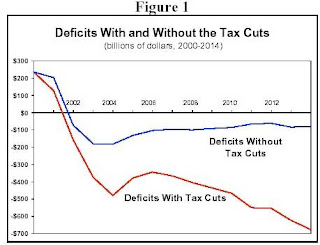
The DailyKos posted several times last year on income inequality and disproportionate benefits of proposed tax cuts, and here is a piece they linked to on income inequality. DailyKos also posted an excellent graph illustrating the deficit with and without tax cuts:

Source: Congressional Budget Office/DailyKos

They also posted this graph on the proportion of the deficit attributed to wars, tax cuts, TARP/recovery measures and the economic downturn itself.

Here is a WaPo graph from last year comparing who receives the benefits from the Bush tax cuts as compared with those originally proposed by Obama. Notably, this wasn’t a new topic in 2010; for example, the NYT wrote this in 2007 on tax cuts benefiting the wealthy. Bloomberg covered Warren Buffet on the wealthy paying more taxes and Newsweek wrote this a year ago on the topic. There is more on this subject from AmericanProgress.org.

Here’s another earlier article from Bloomberg on wealth inequity.

While on the subject of wealth inequity, I will add a note from my own personal experience. Early in my career, I worked on housing for the poor, and I remember it being a revelation to understand that many low-income people pay more for (often substandard) housing over the course of their lifetime than those who are much better-off and are able to own their own homes. This is because the poor have to pay rent every month of their life, and never build any equity. As onerous as 20-30 year mortgages can seem, there is an endpoint at which many mortgage holders will own their houses and the loan payments are done. If you are poor, rent is never done, until you die.

Corporate taxation: While these articles focus on individuals, the role of corporations in the shift of wealth and tax burdens is even more important. This recent Reuters article is about the number of corporations that don’t pay income taxes:

The Government Accountability Office said 72 percent of all foreign corporations and about 57 percent of U.S. companies doing business in the United States paid no federal income taxes for at least one year between 1998 and 2005.

More than half of foreign companies and about 42 percent of U.S. companies paid no U.S.income taxes for two or more years in that period, the report said…

Here are some other reports from truth-out.org and dailykos on this topic. I found that the trend was not new; there were very similar report findings from 2008, for example. Here is more information on the decline of corporate tax revenue and on the percent of federal revenue that comes from corporations.

graph: nationalpriorities.org

Unemployment: Shifting to unemployment, The Atlantic wrote about the “jobless economy.” I also found this reference to a WaPo article positing that a jobless recovery may not be bad. (This is what I mean by things being said that, a generation ago, would have been labeled as extremist positions, but now barely elicit a reaction.)

I also want to refer to Patrick’s excellent post on economic factors, including unemployment and long-term unemployment. This stubborn unemployment provides fertile ground to sow discord and to blame President Obama for not solving problems that he did not create and that have become structurally embedded in the “new economy.”

Firedoglake had this interesting post on the GOP's budget cuts being a "war on jobs" -- predicting the loss of 700,000 jobs. This is the information that Cantor is studiously ignoring.

Krugman worries about the unemployed.

Weakening worker protections, unions and regulations: The Repubs are very openly using the economic crisis as an excuse to weaken environmental and other regulations, and to challenge unions.

Representative Issa has extended an invitation to business to let him know what regulations they want to get rid of; this is also playing out at the state level.

Robert Reich criticized the Republican attack on regulations on HuffPo, and here is a piece on the Republican attack on carbon emission regulations.

Alternet (also here) and many other blogs are covering the attempt to weaken labor. Here is an article from Bloomberg disputing Scott Walker's claims about the public worker unions in Wisconsin.

The attempt to take away hard-won workers' rights is so highly charged, so publicized and so brazen that I am sure all our readers are well aware of it; I will leave more on this subject to other posts.

Weakening Social Security and other programs:

Krugman criticizes proposals to weaken Social Security.

“And having invented a crisis, what do Social Security's attackers want to do? They don't propose cutting benefits to current retirees; invariably the plan is, instead, to cut benefits many years in the future. So think about it this way: In order to avoid the possibility of future benefit cuts, we must cut future benefits. OK.”

Talkingpointsmemo also posted on the current efforts to weaken Social Security.

DailyKos posted this on a new proposal to change federal Medicaid reimbursements into block grants, which would "inevitably" result in reduced coverage and services.

Government spending priorities: Here is a link to the Center on Budget and Policy Priorities on the overall federal spending breakdown, and some basic information from Wikipedia on the U.S. military budget.

Privatization of profit and socialization of risk: Here and here are links on the privatization of profit and the socialization of risk. In this article, the same theme is specifically connected to Big Oil and energy. (I plan to write a post on “Big Oil,” including who gets the profits and who absorbs the risks, in the coming months.) I will go a step further, and suggest that the issue is not only the privatization of profit from private enterprise, but the privatization of profit derived from public dollars; think Halliburton.

Corporate control and consolidation of the media: Patrick and others have written on corporate control of the media, and specifically about the growing influence of the Koch Brothers and Murdoch’s News Corporation; I will not include links now on this topic here, but I expect it will be explored further on PoliticalGates. However, here is a reminder of legislation (1996 Telecommunications Act) that made this possible by weakening anti-trust legislation that had prevented monopolization of media markets, and some basics on the consolidation of the media; another overview on this topic, with links. MediaMatters is an excellent source on this topic, and has a page on financial issues as well.

A different model: I appreciated the NYTimes interactive feature where people could submit their own suggestions for reducing the deficit; based on my own attempts, it is quite feasible to do so through cutting military expenditures and raising taxes on corporations and the wealthy, while maintaining the funding needed to support social, environmental and other programs that benefit this country and its citizens. There is no need to cut Social Security, Medicaid and Medicare to balance the budget.

I thought I would also add to the "conversation" a positive alternative to an economy based on boom and bust cycles, externalization of costs and weakening of worker and citizen protections; this website promotes a different economic model that challenges many economic assumptions.

Conservative voices: As you can see, the sources I’ve referenced range from liberal to non-partisan. To hear directly from conservatives on this subject, I am also linking to a “Conservative Economics 101” piece from The American Spectator. Here is another of their articles, calling for eliminating the corporate income tax.

Of course, I am aware that many PoliticalGaters are fans of Andrew Sullivan, who has a different take on many of these issues as well. While I do not always agree with Andrew on economic issues, I respect his intellect and devotion to facts, and I welcome learning more about his and other reasoned positions backed by data. I agree that running up huge deficits is not good fiscal policy; however, I am more Krugmanian in regards to the need for economic stimuli to get the economy on solid ground before cutting spending; I am also strongly supportive of the wealthy and corporations paying a larger share of the total tax revenue. And, I cannot help but remember that we were running surpluses during Clinton's second term, and the so-called conservatives couldn't wait to get rid of those surpluses through both tax cuts and unaccounted-for-wars. That's why I tend toward a more cynical interpretation of their motives, that they are really more intent on bankrupting the government so that it cannot fund programs that benefit the lower- and middle-class.

In the big picture, I keep coming back to this realization: imagine that, 30 years ago, someone openly proposed such dramatic shifts in wealth, tax burden, weakening of unions and safety net programs. That would have been considered lunatic-fringe extreme (well, think Ayn Rand). Now, it’s mainstream extreme (and, I guess, so is she).

I also find myself asking what allows the Republicans to be so brazen. There’s a psychological aspect, I think – tied to authoritarianism, which I suppose makes it easier to wield power without concern for “the little guy” or the damage done to people’s lives. There’s dogma espoused by Ayn Rand and her followers. Obviously, the Koch Brothers’ funded Tea Party is part of the story, as Patrick has illuminated in prior posts. FOX distortions of the news is another part. The Citizens United decision is a new factor that has tilted the playing field even more than before, allowing more manipulation of public perceptions and dissemination of disinformation than was possible before. These are topics for another day.

As you see, I have just scratched the surface. There is much drilling to be done. But, as a starting point, have at it – what do you think of these ideas? It seems that it should be possible to pull the curtain away from these conservative strategies so that everyone can see what is happening; I really hope that the progressives, liberals, and the middle can work together more effectively to advance a more constructive economic and political agenda.

Update: I just found this new post on Mother Jones, with an excellent graph that is very relevant to this topic.

Tuesday, March 1, 2011

Part 1: A Beginner's Guide to Conservative Politico-Economics

By Blueberry Tart

cartoon: Tom Toles, Washington Post

I preface this post with the admission that I am not an economist, so this is by no means an “expert” post. In fact, my limited knowledge of this subject is exactly what has spurred my interest in exploring it. This is my first, meager attempt to make sense of what is going on in this country politico-economically. You are entirely free to take or leave these ideas – or better yet, improve them!

The post has been at the back of my mind for some time, but I was finally motivated to put pen to paper (so to speak) by how blatant the Republicans’ economic strategies seem. I think the Wisconsin showdown, in particular, helped clarify my thoughts and spurred me to action. The fact that the Republicans are saying and doing things openly about which, a decade or two ago, they were much more circumspect seems a topic worth exploring.

From my vantage point, there seems to be a number of key trends that suggest long-term strategies at work. While predominantly conservative Republican, some of these strategies have been advanced by both Republicans and Democrats, reflecting conservative ideological gains in government that have shifted the overall debate toward the right. These trends include the following:

1) Shifting wealth to a very small segment of the population, as is typical of economic/corporate oligarchies (think banana republic)

2) Making tax increases politically impossible and shifting more of the tax burden from the wealthy and corporations to the middle class and working poor

3) Increasing spending on the military, and running up the deficit with expensive wars (benefitting defense contractors)

4) Using the deficit so-created as an excuse to dismantle the social safety net and other government programs that benefit society

5) Increasing corporate control of or influence over the government

6) Providing tax benefits to corporations even when they eliminate jobs or send them oversees (making a jobless economy even more profitable)

7) Privatizing profits and benefits by providing ways for corporations, and even individuals, to tap into public money (see #1) and insulating some of these gains from taxation (see #2)

8) Externalizing costs and socializing risk by having the public assume the economic (and health, environmental and other) costs of risky decisions

9) Weakening consumer protection, financial and environmental regulation, and social programs (see #5)

10) Weakening organized labor and programs to protect workers and the unemployed, at the same time setting the stage for “jobless recoveries”

11) Facilitating corporate takeover of the media and legalizing monopolization of media markets, thus limiting information and muting voices that support the people’s interests

12) Taking advantage of the unsettling aspects of boom and bust economic cycles to foster crisis- and fear-based decision-making

It may be that some, or all, of these topics warrant their own posts. To begin, rather than expounding on these topics myself, I am putting together a sampling of articles on these subjects, which I'll put up in a new post soon. There are many more, and probably better ones out there, and I’ll bet that Aview999 will lead a “cyber-posse” of our able PoliticalGates readers in collecting them – at least I hope so!

To be continued...