Showing posts with label US economy. Show all posts

Thursday, February 9, 2012

The Sudden Death of the Living Wage : Mitt Romney Flip-Flop 1/3

by Nomad

Romney’s Double Back Flip

Last week Republican front-runner, Mitt Romney somehow managed to flip-flop from the frying pan into the political fire when he told reporters that he didn't fret about the poor because of the social safety net. He explained to a CNN reporter:
“I'm not concerned about the very poor. We have a safety net there. If it needs repair, I'll fix it.”
President as handy-man?
Naturally, like every politician who finds himself in a pickle, he blamed the media for taking his statement out of context. Like his “corporations are people too” remark, Romney once again seemed unable to hear how out of touch he actually sounds. Until everybody else notices. Coming from one of the richest candidates in American history, it gave the (probably accurate) impression that he has no real understanding or sensitivity for the poor. After all, how much more 1% can Mitt Romney be? How can a person like that really represent all of the people?

But then, in order to rectify the gaffe, Romney immediately followed that up with a new problematic statement which had his corporate backers falling out of their cushy chairs. By Wednesday he underlined his commitment to address the problems of the poor by mentioning his support for automatic increases in the federal minimum wage to keep pace with inflation. 
"I haven't changed my thoughts on that," the former Massachusetts governor told reporters aboard his chartered campaign plane, referring to a stand he has held for a decade.
You could almost hear the gasp of a million CEOs and the moan and groan of a thousand Republican Party elites. In that one sentence he confirmed the Right Wing’s darkest suspicions about this candidate. Namely, he is not committed to their agenda after all. Good God, he might even be a moderate, which is next door to a liberal, which is just around the corner from a socialist which is on the same street as a Communist!

Romney’s gaffe has underlined one of the problems facing the Republican party, namely, its inability to deal with poverty except through finger-wagging and starvation. In order to win support, Romney has had to appeal to pro-business groups like the National Federation of Independent Business and the US Chamber of Commerce, both of which reject the idea of any sort of raise in the minimum wage. They have long argued that increased wages are detrimental to economic growth. Both sides of the debate can point to numerous studies to support their respective claims. and economists disagree about the effects of a higher minimum wage on growth and job creation.

A Wage for Living

The birth of the minimum wage law- a landmark of its day- was an agonizing one for President Franklin Roosevelt and it very nearly didn’t occur at all.. After a protracted battle the Supreme court, the president finally succeeded in getting a watered version of his proposal on his desk.. As one source tells us:
In its final form, the act applied to industries whose combined employment represented only about one-fifth of the labor force. In these industries, it banned oppressive child labor and set the minimum hourly wage at 25 cents, and the maximum workweek at 44 hours.
He told the public that America should be able to give "all our able-bodied working men and women a fair day's pay for a fair day's work."

It was hardly what one would call a success story for the president. In order to gain approval in both houses of Congress, numerous compromises, amendments, exemptions and narrowed coverage limits had been added to the original draft. The result was that, in its final form, the act wasn't much of an improvement in the conditions of the working man.  
Congress passed the Fair Labor Standards Act (FLSA) in 1938 and has voted for raises since, but has never linked it to inflation. Over the years Congress revised the FLSA several times, broadening the coverage to include retail establishments in 1961, hospitals, nursing homes, schools and colleges and laundries in 1966 as well as domestic, state and local government workers in 1974. 

The value of the minimum wage and the types of workers it covered have always been widely debated. Despite unwavering public support for regular increases to the federal minimum wage, employer lobbyists, particularly from low-wage industries like restaurants and hotels, have been loud and unyielding opponents. Although the real value of the minimum wage (the value adjusted for inflation) rose consistently from 1938 to 1968, the trend has been reversed ever since. By the end of the 1980s, under a more conservative political climate, the real value had been in decline until 2007.

One thing that many politicians seem unwilling to admit is that minimum wage is actually below the minimum for most people. In many areas of the country, the cost of living (which includes housing, utilities, food, health costs and the bare necessities) exceeds the minimum wage limits and these wage standards only represent the needs of an individual, not those of a family. A minimum wage is merely the amount a money need to survive with the essential items. Often a minimum wage is set so low that it requires some kind of borrowing, like purchases on credit. It may require that the head of the household take on multiple forms of employment or that both parents work.
A minimum wage is not, therefore, a living wage.
To understand the difference, it’s important to remember that a minimum wage is the lowest wage that employers may legally pay to workers and conversely, it’s the lowest rate that a worker can sell his labor. The entire law is designed to represent the employer's interests and not the worker's. (Ideally for the employers, of course, would be a minimum wage set at zero but the Emancipation Proclamation has poo-pooed that idea.) Whether or not a worker (and his dependents) can actually survive on the specified minimum wage is another matter.

For a closer look at a comparison between the living wage and the minimum wage, and to find out what is required to make a living wage in your community, I invite you to visit the Living Wage Calculator.

If we take a random area, Beaufort County, North Carolina. Since the latest increase in the minimum wage, the figures actually look good for a single adult. The minimum wage is $7.25 and that's well above the poverty level at $5.04 and the living wage is $7.14. All very good except when you add a child to equation, the living wage requirement suddenly jumps to $13.98

Another example, Indianapolis: again, minimum wage is $7.25 and the poverty level is $5.04. However, the living wage is $8.06 an hour and with one child, that increases to $15.53.

Finally, a major metropolitan area, Boston. There, the situation is intolerable even without a child. Minimum wage is higher than the federal limit at $8.00 an hour and the poverty level is a mere $5.04. That’s a fairly promising start but then look at the living wage. $12.17. That’s how much you must make an hour in order to live with even the barest essentials. With a child in your lap and you suddenly find you’ll need $20.75 an hour, just to make ends meet. It’s no surprise, then, that people are making use of their credit cards and working two and sometime three jobs. If that becomes impossible, then the only recourse is to become a dependent on the government. 

That’s the safety net that Mitt Romney regales. It's important to remember all this the next time you hear a conservative politician complaining about "class warfare."  There may be class warfare in the America, but it's not the poor who are waging it.

Presentation by Trudi Renwick, Senior Economist, Fiscal Policy Institute
The Invisible Poor
To learn the truth behind American poverty, The Working Poor: Invisible in America, by a former New York Times reporter and a Pulitzer Prize winner, David Shipler, is a “must read.” He examines the problem, not of the unemployed, the so-called welfare queens, the parasites of the free-market economy, but of the gainfully employed labor force who are simply unable to survive on their wages. Moreover, these low-wage jobs that he discusses often don’t provide health insurance coverage, and past medical bills (due to the lack of insurance) often mean low-income families have a substantial debt burden. For the working poor, it's not about saving for a rainy day. Every day is rainy. It's more about just keeping your head above water.
Shipler explains:
Business executives have the skill but certainly not the will to compress salary differentials by raising the bottom and making sacrifices at the top. Revised tax structures could induce such policy. Government has the skill to legislate a big boost in the minimum wage, but it lacks the political will, largely because most low-income Americans don’t vote their interests or don’t vote at all, and can’t compete with private industry’s sophisticated lobbying and campaign contributions. Furthermore, the minimum wage is a blunt instrument, and the skill to use it is not perfected.

One idea for making the tool more refined is to set different minimums for different parts of the country based on regional costs of living. Another approach is the “living wage” law…. We have learned other ways to address the discrepancy between what people can earn in the market and what they need for comfortable living.
As Ralph Waldo Emerson said, discontent is the want of self-reliance. How can one be genuinely self-reliant without being able to afford the bare essentials of subsistence? How can a citizen be fairly represented in government when Congress is (or appears to be) beholden special interests and the demands of the 1%? Above all, it is important that everybody understands that the right to a fair and sustaining wage is a  problem of values.

Not merely because it revolves around the quality of existence or the standard of living but because a fair wage is the key to dignity. And when you rob a person of their dignity, the denial of a life-sustaining wage becomes more than an ethical or even an economic problem,  but a hazard for all of society because a population without dignity, reduced to form of discontented slavery, is an invitation to revolution and to catastrophe.
________________

 In the next post in this series, we will be taking a brief look at that history of the idea of the living wage and what its opponents say about it. 
Retweets

Sunday, December 4, 2011

Middle Class Americans: You are a Tiny Dot

by Leadfoot_LA


(Click to enlarge)

I found this really helpful graphic at MoveOn.org. And by helpful, I mean, it made me feel like crap. Even as someone who falls between the second and third blue dots, I was still shocked by what a speck I am when compared to the 1%.

Can someone please explain to me WHY we have not yet repealed the BushTax Cuts on the Wealthy? We are inthe worst economic situation of our time. How have we not made this very simple and critical adjustment?

This is a graphic going around Facebook that illustrates it well:


Why do I keep hearing people complain every single day that their tax dollars are being wasted on greedy welfare recipients? Listen, teabaggers, you know how much of your tax money is spent on health and human services? SIX PERCENT!


So why on earth do you spend 100% of your time complaining about it? Look at that tiny, almost microscopic blue dot on the grid above. Does that look fun to you? Does that look like a CHOICE anyone would WANT to make?

Don’t you think that it would make more sense to focus your energies on the GIANT green dot instead? You are worried about your money going to others. LOOK AT THE DOTS. Far more of your money is going to the giant green dot. And you’d have far more money of your own if you spent your time and energy stopping corruption in that greendot, than in the microscopic one. Why is this hard to understand?

I can’t wait until 2012 when the tea party disappears forever. Then we will all need these to wash the bad taste out of our mouths.

Saturday, August 6, 2011

Collected Rants About The Economy

By Ennealogic

Inflation chart, showing relative gold pricing
Inflation - Keeping prices from going up is supposed to be a good thing. That means that costs have to be held in check. Wages are part of costs. That means wages have to remain stagnant, doesn't it? Or fewer people have to produce what more did before, which causes unemployment. So, is inflation good or bad? Which reminds me, those who most wanted us to default on our US debt payments are pretty much the same people who have been recommending purchasing gold. I wonder why?


Bills and coins, representations of wealth
Money - Bills and coins by themselves are only representations of wealth. Where does wealth come from? Boiling it down to the raw ingredients, I get earth's resources plus human effort. The basic resources on which everything else depends are minerals and water. It takes minerals and water for all organisms, plants and trees to grow. Harvesting raw materials and turning them into products like food and building materials takes human effort. But are raw materials infinite? I don't think so. That means we will run out of them eventually. That also means that wealth is not infinite. Some will suck the wealth out of the earth and out of human effort. The trouble begins when those doing the most sucking think, "It's MY money and nobody can force me to share it!" when in fact, all they really did was finagle their way into usurping finite raw materials and cheap human labor.


Unemployment levels are devastating
Unemployment - If people can't get jobs, it's because employers aren't hiring. If employers are not hiring, it's because they don't need the workers to provide the goods and services. If companies are not providing goods and services, it's because not enough people are buying them. If not enough people are buying what companies are selling, it's probably because they don't have enough money to spend. People probably don't have enough money to spend because not enough people have good-paying jobs. This also means that tax revenues decrease because not enough people are earning and having deductions taken out. And when that happens, government doesn't have much money to spend on stimulus, but then nobody else will either. And there you have, in a nutshell, why cutting expenses in a broadly-based economic slowdown is insane. Or, my opinion of insanity anyway!

Growth of population courtesy Al Gore
Population - As more and more people are born on the planet, resources get spread thinner and thinner. Can everyone on earth have a bagful of diamonds? Or a Lexus? Probably not, because there wouldn't be enough raw materials to go around. When fewer resources are available, prices go up, leaving more people having to make do with less. Al Gore's population chart, the one that spans eons, is illustrative of the real crisis we face. How to feed and take care of billions upon billions of people? How to compensate for all that human activity? How to begin to address this problem that almost nobody ever talks about?


Stock market or gambling?

Stock Market - I've wondered where the money is coming from when a stock rises and where it goes when a stock falls. The stock market is like a giant game of chance, a lottery game. Except in this game the savvy people, the ones with inside information, prey upon the less educated and less connected. 'Playing the market' lets those who have take from those who want to have. It's like a big recycling scheme where the 'wealth' sifts to the top. The image that comes to mind is when you shake a bucket that has sand, pebbles, and stones in it. The largest stones will end up on top, always. Who ends up losing? The billion grains of sand at the bottom…

For-profit health care killing us all
Health Care - It seems to me that if people are making profits, over and above salary and costs, for helping sick people, that we have ourselves a system ripe for abuse, corruption, and basic greed. How could health care costs NOT go up when the companies who provide the services are in it for the profit? Even small town country doctors are being absorbed into health care collectives, who have their own rules about which insurances they'll accept, and whether or not you can still visit them, and whether or not they are associated with local hospitals who now also have to belong to a collective. One more scary thing -- what incentives are there for helping people get well if every office visit and lab test and drug purchase yields a profit? Who wants to send a paying customer right out of the door?


Teaching has been amputated in favor of testing
Education - If those in power want to stay in power (and we know who they are), it makes sense they would not want well-educated, honest and ideologically progressive young people rising up to challenge that power. We still do have public schools, but for the last 10 years (a long time in a child's life) teachers and schools have been stymied by having to make sure their kids pass rote tests thanks to GW Bush's NCLB (may he rot in texas) instead of experiencing the absolute JOY of learning how to learn. Memorizing things is not even close to learning things. In fact, I would argue that having to memorize things puts a damper on curiosity and invention and love of learning for its own sake. Demoralized teachers equals lackadaisical students equals brain-challenged citizens. Just the way some at the top may like it, eh? And if the dominionists have their way, education will become even more retarded and focused on a religious framework.

I guess all this is to say, we face a boatload of ultra-serious problems, far more devastating in the long term than defaulting on a payment to KBR, or even our Social Security recipients.

In order that this post not be a complete downer, here's a video I found a while back that just blew my mind, and pumps up my hope in the human spirit (remember the need in Africa).


+++

BONUS:

Our reader Azure Ghost created another one of her smart compositions concerning Sarah Palin - this one should be spread wide as well (click to enlarge):

"Because actual fighting is so passé."

You can re-tweet this picture HERE.

Wednesday, March 2, 2011

Part 2: A Beginner's Guide to Conservative Politico-Economics

By Blueberry Tart

cartoon by Tom Toles

(See Part 1 for my introduction to the topic of conservative political and economic trends.)

Let’s start with Paul Krugman, a Nobel Prize winning economist and prolific author who has a gift for saying complex things in terms that regular people can grasp. With no apologies, he is a dyed-in-the-wool liberal. In addition to his many books and scholarly papers, he has written extensively about some of these economic themes on the NYT opinion pages and blog. I thought his first blog post (pre-economic meltdown) set the tone well for the topics I am exploring:

Because of movement conservative political dominance, taxes on the rich have fallen, and the holes in the safety net have gotten bigger, even as inequality has soared. And the rise of movement conservatism is also at the heart of the bitter partisanship that characterizes politics today.

This post speaks to my overall topic -- the conservative movement's "long game" which is reshaping core assumptions about the role of government, fair labor practices, the social safety net and other key politico-economic factors -- and rewriting history (successfully, to some extent) about Social Security and the role of deregulation in fomenting the financial crisis, for example.

Krugman has written several articles and blog posts about the role deregulation played in getting us into the economic meltdown; this began with Reagan and accelerated on GWBush’s watch. He has also written on the importance of more government spending to get us out of the mess and debunked what he says are myths about government spending. He is especially concerned that cutting government spending threatens to repeat a mistake that stalled recovery during the Great Depression; here is more on that topic.

Supporting this premise, here is a recent piece from Bloomberg on how cutbacks in state government spending have slowed the recovery.

Income/wealth inequality and the shifting burden of taxation: Next, Mother Jones had a post just this past week, with excellent graphs illustrating points 1 and 2 from my Part 1 post. I am reproducing several here; I encourage you to take a look at the whole series, as they are very informative. (Apologies to those who struggle to understand graphs; some of this information is hard to present otherwise.)

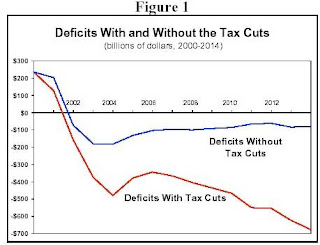
The DailyKos posted several times last year on income inequality and disproportionate benefits of proposed tax cuts, and here is a piece they linked to on income inequality. DailyKos also posted an excellent graph illustrating the deficit with and without tax cuts:

Source: Congressional Budget Office/DailyKos

They also posted this graph on the proportion of the deficit attributed to wars, tax cuts, TARP/recovery measures and the economic downturn itself.

Here is a WaPo graph from last year comparing who receives the benefits from the Bush tax cuts as compared with those originally proposed by Obama. Notably, this wasn’t a new topic in 2010; for example, the NYT wrote this in 2007 on tax cuts benefiting the wealthy. Bloomberg covered Warren Buffet on the wealthy paying more taxes and Newsweek wrote this a year ago on the topic. There is more on this subject from AmericanProgress.org.

Here’s another earlier article from Bloomberg on wealth inequity.

While on the subject of wealth inequity, I will add a note from my own personal experience. Early in my career, I worked on housing for the poor, and I remember it being a revelation to understand that many low-income people pay more for (often substandard) housing over the course of their lifetime than those who are much better-off and are able to own their own homes. This is because the poor have to pay rent every month of their life, and never build any equity. As onerous as 20-30 year mortgages can seem, there is an endpoint at which many mortgage holders will own their houses and the loan payments are done. If you are poor, rent is never done, until you die.

Corporate taxation: While these articles focus on individuals, the role of corporations in the shift of wealth and tax burdens is even more important. This recent Reuters article is about the number of corporations that don’t pay income taxes:

The Government Accountability Office said 72 percent of all foreign corporations and about 57 percent of U.S. companies doing business in the United States paid no federal income taxes for at least one year between 1998 and 2005.

More than half of foreign companies and about 42 percent of U.S. companies paid no U.S.income taxes for two or more years in that period, the report said…

Here are some other reports from truth-out.org and dailykos on this topic. I found that the trend was not new; there were very similar report findings from 2008, for example. Here is more information on the decline of corporate tax revenue and on the percent of federal revenue that comes from corporations.

graph: nationalpriorities.org

Unemployment: Shifting to unemployment, The Atlantic wrote about the “jobless economy.” I also found this reference to a WaPo article positing that a jobless recovery may not be bad. (This is what I mean by things being said that, a generation ago, would have been labeled as extremist positions, but now barely elicit a reaction.)

I also want to refer to Patrick’s excellent post on economic factors, including unemployment and long-term unemployment. This stubborn unemployment provides fertile ground to sow discord and to blame President Obama for not solving problems that he did not create and that have become structurally embedded in the “new economy.”

Firedoglake had this interesting post on the GOP's budget cuts being a "war on jobs" -- predicting the loss of 700,000 jobs. This is the information that Cantor is studiously ignoring.

Krugman worries about the unemployed.

Weakening worker protections, unions and regulations: The Repubs are very openly using the economic crisis as an excuse to weaken environmental and other regulations, and to challenge unions.

Representative Issa has extended an invitation to business to let him know what regulations they want to get rid of; this is also playing out at the state level.

Robert Reich criticized the Republican attack on regulations on HuffPo, and here is a piece on the Republican attack on carbon emission regulations.

Alternet (also here) and many other blogs are covering the attempt to weaken labor. Here is an article from Bloomberg disputing Scott Walker's claims about the public worker unions in Wisconsin.

The attempt to take away hard-won workers' rights is so highly charged, so publicized and so brazen that I am sure all our readers are well aware of it; I will leave more on this subject to other posts.

Weakening Social Security and other programs:

Krugman criticizes proposals to weaken Social Security.

“And having invented a crisis, what do Social Security's attackers want to do? They don't propose cutting benefits to current retirees; invariably the plan is, instead, to cut benefits many years in the future. So think about it this way: In order to avoid the possibility of future benefit cuts, we must cut future benefits. OK.”

Talkingpointsmemo also posted on the current efforts to weaken Social Security.

DailyKos posted this on a new proposal to change federal Medicaid reimbursements into block grants, which would "inevitably" result in reduced coverage and services.

Government spending priorities: Here is a link to the Center on Budget and Policy Priorities on the overall federal spending breakdown, and some basic information from Wikipedia on the U.S. military budget.

Privatization of profit and socialization of risk: Here and here are links on the privatization of profit and the socialization of risk. In this article, the same theme is specifically connected to Big Oil and energy. (I plan to write a post on “Big Oil,” including who gets the profits and who absorbs the risks, in the coming months.) I will go a step further, and suggest that the issue is not only the privatization of profit from private enterprise, but the privatization of profit derived from public dollars; think Halliburton.

Corporate control and consolidation of the media: Patrick and others have written on corporate control of the media, and specifically about the growing influence of the Koch Brothers and Murdoch’s News Corporation; I will not include links now on this topic here, but I expect it will be explored further on PoliticalGates. However, here is a reminder of legislation (1996 Telecommunications Act) that made this possible by weakening anti-trust legislation that had prevented monopolization of media markets, and some basics on the consolidation of the media; another overview on this topic, with links. MediaMatters is an excellent source on this topic, and has a page on financial issues as well.

A different model: I appreciated the NYTimes interactive feature where people could submit their own suggestions for reducing the deficit; based on my own attempts, it is quite feasible to do so through cutting military expenditures and raising taxes on corporations and the wealthy, while maintaining the funding needed to support social, environmental and other programs that benefit this country and its citizens. There is no need to cut Social Security, Medicaid and Medicare to balance the budget.

I thought I would also add to the "conversation" a positive alternative to an economy based on boom and bust cycles, externalization of costs and weakening of worker and citizen protections; this website promotes a different economic model that challenges many economic assumptions.

Conservative voices: As you can see, the sources I’ve referenced range from liberal to non-partisan. To hear directly from conservatives on this subject, I am also linking to a “Conservative Economics 101” piece from The American Spectator. Here is another of their articles, calling for eliminating the corporate income tax.

Of course, I am aware that many PoliticalGaters are fans of Andrew Sullivan, who has a different take on many of these issues as well. While I do not always agree with Andrew on economic issues, I respect his intellect and devotion to facts, and I welcome learning more about his and other reasoned positions backed by data. I agree that running up huge deficits is not good fiscal policy; however, I am more Krugmanian in regards to the need for economic stimuli to get the economy on solid ground before cutting spending; I am also strongly supportive of the wealthy and corporations paying a larger share of the total tax revenue. And, I cannot help but remember that we were running surpluses during Clinton's second term, and the so-called conservatives couldn't wait to get rid of those surpluses through both tax cuts and unaccounted-for-wars. That's why I tend toward a more cynical interpretation of their motives, that they are really more intent on bankrupting the government so that it cannot fund programs that benefit the lower- and middle-class.

In the big picture, I keep coming back to this realization: imagine that, 30 years ago, someone openly proposed such dramatic shifts in wealth, tax burden, weakening of unions and safety net programs. That would have been considered lunatic-fringe extreme (well, think Ayn Rand). Now, it’s mainstream extreme (and, I guess, so is she).

I also find myself asking what allows the Republicans to be so brazen. There’s a psychological aspect, I think – tied to authoritarianism, which I suppose makes it easier to wield power without concern for “the little guy” or the damage done to people’s lives. There’s dogma espoused by Ayn Rand and her followers. Obviously, the Koch Brothers’ funded Tea Party is part of the story, as Patrick has illuminated in prior posts. FOX distortions of the news is another part. The Citizens United decision is a new factor that has tilted the playing field even more than before, allowing more manipulation of public perceptions and dissemination of disinformation than was possible before. These are topics for another day.

As you see, I have just scratched the surface. There is much drilling to be done. But, as a starting point, have at it – what do you think of these ideas? It seems that it should be possible to pull the curtain away from these conservative strategies so that everyone can see what is happening; I really hope that the progressives, liberals, and the middle can work together more effectively to advance a more constructive economic and political agenda.

Update: I just found this new post on Mother Jones, with an excellent graph that is very relevant to this topic.