Showing posts with label supreme court. Show all posts

Saturday, December 13, 2014

Antonin Scalia, the Supreme Court Justice from hell, falsely claims in speech that the "US Constitution does not contravene torture" - and says other very silly things as well, as usual

Supreme Court Justice Antonin Scalia: Incompetence personified

By Patrick

If there was a TV-program called "America's Worst Judges", then Supreme Court Justice Antonin Scalia would be the most convincing participant, no doubt about it. It is already assured that his name will live in infamy, due to uncountable awful or even horrifying remarks and decisions. But there is always a way to make things even worse, this Supreme Court Justice from hell apparently thought. While virtually everybody around the world and in the USA (excluding the lovers of dictatorships and authoritarian regimes) is deeply shocked about the contents of the recently published US Senate torture report, Justice Scalia apparently does not believe that torture is such a big deal, and now said that he could find nothing in the US Constitution that contravenes torture.

The Associated Press reports:

Supreme Court Justice Antonin Scalia is joining the debate over the Senate's torture report by saying it's hard to rule out the use of extreme measures to extract information if millions of lives were threatened.

Scalia told a Swiss broadcast network that American and European liberals who say such tactics may never be used are being self-righteous.

The 78-year-old justice said he doesn't "think it's so clear at all," especially if interrogators were trying to find a ticking nuclear bomb. Scalia has made similar comments in the past, but he renewed his remarks on Wednesday in an interview with Radio Television Suisse, a day after the release of the Senate report detailing the CIA's harsh interrogation of suspected terrorists. RTS aired the interview on Friday.

"Listen, I think it's very facile for people to say, 'Oh, torture is terrible.' You posit the situation where a person that you know for sure knows the location of a nuclear bomb that has been planted in Los Angeles and will kill millions of people. You think it's an easy question? You think it's clear that you cannot use extreme measures to get that information out of that person?" Scalia said.

Scalia also said that while there are U.S. laws against torture, nothing in the Constitution appears to prohibit harsh treatment of suspected terrorists. "I don't know what article of the Constitution that would contravene," he said. Scalia spent a college semester in Switzerland at the University of Fribourg.

Oh, so it's all fine then! There are unnamed "U.S. laws", but the constitution is OK with torture, right? Well, thanks for clearing that up, Justice Scalia. Finally, everyone involved doesn't need to have a bad conscience any more.

You really need to be a brain-dead teabagger to believe this. For those people who are not totally brainwashed or completely incapable of independent thinking, the evidence to the contrary is not difficult to find, and you can bet that every law student would fail his exam if he or she claimed that Justice Scalia was correct. Because such a statement is nothing more than a very dangerous distortion of the Constitution.

Let's for example take a look at the "U.N. Convention against Torture and Other Cruel, Inhuman or Degrading Treatment or Punishment" (commonly known as the "United Nations Convention against Torture"). The USA ratified the Convention in 1994.

The ratification of this Convention makes it a "treaty" according to the US Constitution's Supremacy Clause [Article VI, Clause 2]. These treaties are one of the three things that are the supreme law of the land. The other two are the Constitution itself and federal laws (see also here).

In Article one of the U.N. Convention, torture is clearly defined as:

Any act by which severe pain or suffering, whether physical or mental, is intentionally inflicted on a person for such purposes as obtaining from him or a third person, information or a confession, punishing him for an act he or a third person has committed or is suspected of having committed, or intimidating or coercing him or a third person, or for any reason based on discrimination of any kind, when such pain or suffering is inflicted by or at the instigation of or with the consent or acquiescence of a public official or other person acting in an official capacity. It does not include pain or suffering arising only from, inherent in or incidental to lawful sanctions.

Which of course fully covers the actions of the CIA and their money-grubbing as well as conscience-free contractors during the "enhanced interrogations" as described in the US Senate torture report.


But is Justice Scalia still right? It's not in the Constitution, right? It might be the "supreme law of the land", but hey, the Constitution itself doesn't talk about torture?

A Supreme Court Justice should know that constitutional matters are not that easy, but when Justice Scalia was appointed by Ronald Reagan to the Supreme Court in 1986, I very much doubt that his professional skills as a lawyer played the major role. So it is not surprising, but still pretty shocking, that Scalia comes across as the "Dumb of Dumber" of the Supreme Court.

Coming from a country where Supreme Court Justices are actually chosen due to their outstanding legal skills in the first place (political considerations come second), which is interesting because the German Constitutional Court was modeled after the US Supreme Court after WWII, I can just continue to scratch my head about the fact that US politicians have no problem to erode their democratic system by appointing incompetent candidates to the Supreme Court, who are obviously chosen for their political persuasions in the first place, or only for their political persuasions. When I say "US politicians", I do talk about Republicans in the first place, of course, as for example President Obama made great choices when it came to the selection of candidates for the Supreme Court.

During my own legal education in Germany, I personally met two German Supreme Court Justices in seminars, and can confirm that the lawyers who are chosen for the court are truly excellent. When appointing the judges, who are serving a 12-year-term, the politicians look for the best and brightest. The reputation of the German Constitutional Court has been very high throughout the decades, and the Court is responsible for many landmark decisions, which helped to establish a free and liberal political system. I can safely say that appointing an idiot like Scalia to the Court would be absolutely inconceivable in Germany and has so far never happened since the Court was established after WWII. Also, I am not aware that politicians in Germany have ever tried to abuse the German Constitutional Court for political gain.

But back to Scalia's claim! We still haven't fully refuted it yet, right? Well, we are in luck! Because when it comes to United Nations Convention against Torture, each country had the opportunity to submit a detailed report. The USA also submitted such a very extensive and detailed report, written in October 1999, and explained in detail why torture is prohibited by the US Constitution! Let's take a look and enlighten ourselves, even though there is apparently no hope left with Justice Scalia!


Excerpt:

1. The Government of the United States of America welcomes the opportunity to report to the Committee against Torture on measures giving effect to its undertakings under the Convention against Torture and Other Cruel, Inhuman or Degrading Treatment or Punishment, in accordance with article 19 thereof. The organization of this initial report follows the revised General Guidelines of the Committee against Torture regarding the form and content of initial reports to be submitted by States parties (CAT/C/4/Rev.2).

2. This report has been prepared by the U.S. Department of State with extensive assistance from the Department of Justice and other relevant departments and agencies of the Federal Government. Substantial contributions were also solicited and received from interested non-governmental organizations, academics and private citizens. The report covers the situation in the United States and the measures taken to give effect to the Convention through September 1999.

3. The United States ratified the Convention against Torture in October 1994, and the Convention entered into force for the United States on 20 November 1994. In its instrument of ratification (deposited with the Secretary General of the United Nations on 21 October 1994), the United States made a declaration pursuant to article 21, paragraph 1, recognizing the competence of the Committee against Torture, on a reciprocal basis, to receive and consider a State party’s claims that another State party is not fulfilling its obligations under the Convention. The United States also conditioned its ratification on two reservations and a number of interpretive understandings; these are included at annex I and discussed at the relevant portions of this report.

4. In 1992 the United States became a party to the International Covenant on Civil and Political Rights, some provisions of which may be considered to have wider application than those of the Convention against Torture. The initial United States report under the Covenant, which provides general information related to United States compliance with and implementation of obligations under the Covenant, was submitted to the Human Rights Committee in July 1994 (see HRI/CORE/1/Add.49 and CCPR/C/81/Add.4). The United States also ratified the International Convention on the Elimination of All Forms of Racial Discrimination at the same time as it ratified the Convention against Torture. In February 1995 the United States signed the Convention on the Rights of the Child.

5. The United States has long been a vigorous supporter of the international fight against torture. United States representatives participated actively in the formulation of the United Nations Declaration on the Protection of All Persons from Being Subjected to Torture and Other Cruel, Inhuman or Degrading Treatment or Punishment, adopted in 1975, and in the negotiation of the Convention against Torture. The United States continues to be the largest donor to the United Nations Voluntary Fund For Victims of Torture, having contributed over $12.6 million as of August 1999. The United States Government pursues allegations of torture by other governments as an integral part of its overall human rights policy, highlighting such issues in its annual Country Reports on Human Rights Conditions.

6. Torture is prohibited by law throughout the United States. It is categorically denounced as a matter of policy and as a tool of state authority. Every act constituting torture under the Convention constitutes a criminal offence under the law of the United States. No official of the Government, federal, state or local, civilian or military, is authorized to commit or to instruct anyone else to commit torture. Nor may any official condone or tolerate torture in any form. No exceptional circumstances may be invoked as a justification of torture. United States law contains no provision permitting otherwise prohibited acts of torture or other cruel, inhuman or degrading treatment or punishment to be employed on grounds of exigent circumstances (for example, during a “state of public emergency”) or on orders from a superior officer or public authority, and the protective mechanisms of an independent judiciary are not subject to suspension. The United States is committed to the full and effective implementation of its obligations under the Convention throughout its territory.

That sounds already quite good, doesn't it? I especially like this sentence:

"No exceptional circumstances may be invoked as a justification of torture. "

This was of course before the Bush-cabal tried to bend and distort the applicable laws.

If this was not clear enough yet for Justice Scalia, he is in luck, because there is much more - just another short excerpt from this extremely interesting document:

47. In 1994, Congress enacted a new federal law to implement the requirements of the Convention against Torture relating to acts of torture committed outside United States territory. This law, which is codified at 18 U.S.C. § 2340 et seq., extends United States criminal jurisdiction over any act of (or attempt to commit) torture outside the United States by a United States national or by an alleged offender present in the United States regardless of his or her nationality. The statute adopts the Convention’s definition of torture, consistent with the terms of United States ratification. It permits the criminal prosecution of alleged torturers in federal courts in specified circumstances.

48. Any act falling within the Convention’s definition is clearly illegal and prosecutable everywhere in the country. Because existing criminal law was determined to be adequate to fulfil the Convention’s prohibitory obligations, and in deference to the federal-state relationship, it was decided at the time of ratification not to propose enactment of an omnibus implementing statute for the Convention or to adopt a single federal crime of torture.

49. Torture has always been proscribed by the Eighth Amendment to the United States Constitution, which prohibits “cruel and unusual punishments”. This Amendment is directly applicable to actions of the Federal Government and, through the Fourteenth Amendment, to those of the constituent states. See Robinson v. California, 370 U.S. 660, reh’g den. 371 U.S. 905 (1962); Estelle v. Gamble, 429 U.S. 97 (1976). While the constitutional and statutory law of the individual states in some cases offers more extensive or more specific protections, the protections of the right to life and liberty, personal freedom and physical integrity found in the Fourth, Fifth and Eighth Amendments to the United States Constitution provide a nationwide standard of treatment beneath which no governmental entity may fall. The constitutional nature of this protection means that it applies to the actions of officials throughout the United States at all levels of government; all individuals enjoy protection under the Constitution, regardless of nationality or citizenship.

50. Every state constitution also contains detailed guarantees of individual liberties, in most cases paralleling the protections set forth in the federal bill of rights. For example, nearly all state constitutions expressly forbid cruel and unusual punishment (including acts constituting “torture”) and guarantee due process protections no less stringent than those in the federal Constitution. The constitutions of 33 states also contain specific protections against unreasonable searches and seizures; only two state constitutions lack explicit protection against self-incrimination in criminal cases; and only five lack double jeopardy clauses. Even in such cases, however, defendants are not deprived of the protections afforded by the federal Constitution: United States constitutional protections are applicable throughout the United States, and the constitutional due process provision is broadly construed by the courts. In some cases, state law guarantees rights not explicitly recognized by the federal Constitution (such as privacy, education or access to courts), the protections afforded by state law sometimes exceeds those required by the federal Constitution.

More:

112. Other constitutional provisions. Because the Eighth Amendment by its terms applies to “punishments”, courts have looked to other constitutional provisions, in particular the Fourth Amendment’s protections against unreasonable searches and seizures and the due process requirements of the Fifth and Fourteenth Amendments, to preclude the abuse or ill-treatment of individuals in other custodial circumstances. These constitutional protections are applicable and enforced at all levels of government.

(...)

114. The Fourteenth Amendment provides that “[n]o State [shall] deprive any person of life, liberty or property without due process of law”. The Fifth Amendment applies to the Federal Government and similarly provides that no person shall “be deprived of life, liberty, or property without due process of law”. The principle of due process provides a broad and flexible measure of protection against abuse of state power. The due process clauses of the Fifth and Fourteenth Amendments may reach actions that are technically outside Eighth Amendment purview, such as excessive use of force by law enforcement personnel during the investigative or pre-trial stages. Denial of pre-trial release by itself may implicate substantive and procedural due process concerns. United States v. Salerno, 481 U.S. 739 (1987).

115. Although the Eighth Amendment does not apply to “pre-trial detainees”, i.e., persons lawfully arrested but not yet convicted and sentenced, the courts have ruled that such individuals enjoy equivalent protection under the Fourteenth Amendment with regard to conditions of detention. “[S]tates may not impose on pre-trial detainees conditions that would violate a convicted person’s Eighth Amendment rights.” Hamm v. DeKalb County, 774 F.2d 1567, 1573-74 (11th Cir. 1985), cert. denied 475 U.S. 1096 (1986). See also Graham v. Connor, 490 U.S. 386 (1989) (the Due Process Clause of the Fourteenth Amendment protects a pre-trial detainee from the use of force that amounts to punishment); Bell v. Wolfish, 441 U.S. 520 (1979); Ingraham v. Wright, 430 U.S. 651 (1977). In Lancaster v. Monroe County, Ala., 116 F.3d 1419 (11th Cir. 1997), a federal court of appeal stated that the minimum standard of medical care owed to a pre-trial detainee under the Fourteenth Amendment is the same as that required under the Eighth Amendment for a convicted prisoner.

Unless one is smitten with total ignorance, or is just plain malicious, there is simply no way to claim that the US Constitution is "silent" about torture.

This has of course long been acknowledged in the media as well. In an editorial, the Washington Post for example already wrote in 2005:

Interpreting the Constitution as permitting waterboarding in secret prisons is, to most experts outside the administration, legally outrageous and politically untenable. It means that the Bush administration accepts, in principle, that the FBI may use waterboarding, painful stress positions, forced nudity and other methods on Americans, in American prisons, "in certain circumstances." That's why the Justice Department has classified its memos on the subject and kept its conclusions secret. That's why President Bush and Vice President Cheney have worked so hard to stop the McCain amendment, which would pave the way for legal challenges to their interpretation. They want to give themselves the authority to commit human rights abuses without having to explain or justify themselves to the public, the world -- or an impartial court.

By the way, the United Kingdom in contrast does not even have a written constitution. According to Justice Scalia's logic, virtually everything would be constitutionally permitted then, as there clearly is "nothing" in there! Not even a piece of paper! Somebody should quickly tell the UK politicians, I am sure they will be thrilled.

Finally:

Justice Scalia said in this interview several other outrageous things, as it is obviously his very own "personal style." The darling of the teabaggers strikes again, the AP report is actually very detailed, which is good to see:

The 30-minute interview touched on a range of topics, including the financing of political campaigns, the death penalty and gay marriage, about which Scalia said he should not comment because it is likely the court soon will have the issue before it. Asked about money and U.S. elections, Scalia scoffed that "women may pay more each year to buy cosmetics" than is spent on local, state and federal elections combined.

Women spend more money on cosmetics!! What an ingenious argument!

Dear US Republicans - you might think you are winning right now, but I don't think it will end well. Your lot is simply too stupid for your own good. All the dirty tricks and brainwashing won't help. The dark side will always be the loser in the end.

Have a nice weekend, everybody!

Wednesday, July 2, 2014

American Exceptionalism, Republican Tea Party Style

by Sunnyjane

Name one American who lost a freedom when Michael Sam kissed his partner.  
The Tea Party radicals in what passes for today's GOP has two pat phrases in their anti-democracy arsenal: Taking Back America and American Exceptionalism.  Obviously, they believe that by accomplishing the former, they can achieve the latter.  Was the USA considered exceptional way back in 1780?  I forget.

These days, Tea Party American Exceptionalism seems to consist of, but is not limited to, being first in gun deaths, first in starting wars, first in preventing women from securing proper health care, and first in denying anything that has the slightest whiff of that scientific stuff.

Let's look at a few examples.

When Religion Trumps Science

(Image courtesy of The Daily Beast)
After years of exhaustive research, Biblical scholars have unanimously determined that not all modern advances in gynecology can be found in the New Testament.  And yet, the fate of American women's health is in jeopardy because of five Roman Catholic justices -- Kennedy, Roberts, Alito, Thomas, and Scalia.  Sorry, guys, but your religion is not supposed to harm other Americans.

Let's get something straight here:  The Supreme Court's decision favoring Hobby Lobby and Conestoga Wood in this suit is not about their religious beliefs.  Hobby Lobby buys their craft-crap from China, where abortion is frequently mandated by the government; the company's pension plan holds $73 million that invests in pharmaceutical companies that manufacture emergency contraceptive pills, intrauterine devices, and abortion-inducing medications;  and their former healthcare plans provided for these same medications, without objection.

No, this is about putting the first scalpel to the Affordable Care Act, and it is just the beginning.  The President's enemies will continue to employ death by a thousand cuts to slowly rip  apart a badly needed -- and very popular -- healthcare law that covers millions of people in this country, all out of spite.

Is that American Exceptionalism?

Needlessly Poisoned by the Air We Breathe

A bunch of science (eek!) advisers is imploring the Environmental Protection Agency to enact stricter limits on ozone, which is adversely affecting the most vulnerable in our country.  Children, the elderly, and citizens with asthma are experiencing a decrease in lung function and an increase in respiratory symptoms and airway inflammation.

Of course, the GOP wants to do away with the EPA because they don't care to hear news like that and they don't believe in all that sciencey stuff anyhow.  Isn't that sort of like burning down your house because you dislike the color it's painted?

So what if Grandma and the kids are sick?  Take 'em to the doctor and get 'em some medicine!  Unless, of course, they don't have healthcare, and then...

Is that American Exceptionalism?

Who Needs Gun Control?  We Need People Control!

The gun lobby's creed.
Several posts ago we had some, um, out-of-town pro-gun visitors to Politicalgates. They didn't hang around long and, in general, were not terribly obnoxious.  For one thing, those of us who replied to their comments kept asking for citations to their statements; few were forthcoming.

But I did take the time to research some of their assertions and found one that was correct: The sale of guns is going down.  It certainly does not seem that that is the case, considering all the crazies who are open-carrying and shooting anything that moves.  However, here's the key: the NRA, gun dealers, and gun manufacturers are in a panic over this situation, and have resorted to appealing to the fringe elements in our society. 

The NRA fully supported universal background checks -- including at gun sale events -- after the Columbine High School massacre in 1999.  Today, however,  background checks are too cumbersome, too intrusive, and too inefficient.  (Translation:  Holy Shit, those damn background checks are lowering our sales!)  So bring on the likes of Ted Nugent to appeal to the fringe.  And though not exactly how he wanted it, Glenn Beck exposed the NRA as anti-government extremists.

How's that for American Exceptionalism?   

Some Exceptional American 2014 GOP Candidates   

We're not going to have any more candidates who are unelectable!
Which one of these two headlines is a Daily Currant satire piece and which is real:
    
      Todd Akin Claims Breastmilk Cures Homosexuality

or

    GOP Candidate Charges Opponent Is Dead, Represented By A Body Double
 
I know, I know...it's difficult.  Actually, the Todd Akin headline is from the Daily Currant; the other one is true, and that is scary.  Timothy Ray Murray believes that Oklahoma GOP Rep. Frank Lucas was found guilty of something or other and was put to death in Ukraine several years ago.  All you have to know here is Frank Lucas as never been to Ukraine and he appears to be very much alive.  Snort!

Cesar Chavez -- the Arizona guy who changed his name and his party to try to win an election -- didn't even get a chance this time: a judge disallowed half of the signatures on his nomination forms because they were illegible.  Oops!

A Michigan slug wants citizens to forgive and forget about his criminal activities and his weird sexual fetishes and vote for him to join the state legislature.  Uh huh. 
     
And speaking of slugs people who want to be a candidate, you have to wonder what Priebus thinks the GOP's chances are when three potential 2016 saviors -- Christie, Walker, and Perry -- are embroiled in Grand Jury investigations.  Added to them, of course, is once-golden boy Bob McDonnell.  His trial starts July 28.

What wonderful GOP representatives of American Exceptionalism.

End Note

Tuesday, July 16, 2013

The Right to Vote Shall Not be Infringed

by Sunnyjane

In 1964, President Lyndon Baines Johnson signed the Civil Rights Act, which made it illegal to discriminate against citizens based on their gender (women), race, ethnicity, national origin, or religion.

The Voting Rights Act was signed the following year with the sole intention of prohibiting state and local governments from imposing any qualification or prerequisite to voting that would deny or abridge the right of any citizen of the United States to vote on account of race or color.  To ensure compliance in states and specific localities with a history of discrimination, precise guidelines were put in place -- Sections 4 and 5 -- that required Department of Justice approval for changes in voting laws, processes, or procedures.

Where Men (and Women) Were NOT Created Equal


In what has always been hailed as a free country, it is embarrassing to people of good conscience to remember that many of our fellow citizens were denied the opportunity to vote due simply to the color of their skin.  And yet, it was so.

Because of the Constitution's Fifteenth Amendment, which became law in 1870 and banned federal and state governments from denying a citizen the right to vote based on race, color, or previous condition of servitude, it was illegal to be so obviously discriminatory as to post Whites Only signs at voter registration and polling sites.  However, racists always find a way around any law that actually gives a person of color a freedom that whites enjoy.  In some southern states -- and in California, oddly enough -- a poll tax was instituted that required every black to pay $2.00 just to vote.  That may not seem like a large amount today, but considering the mostly seasonal employment of black communities in the south, $4.00 for a husband and wife was tantamount to taking food out of the mouths of their children.

Other southern states were even more hostile to the idea of blacks voting, and actually required that African Americans pass what was cleverly referred to as a literacy test.  In Alabama, the test was administered by a white person -- who was solely responsible for deciding who passed and who didn't -- and the questions went like so: Name all the sixty-seven judges in the state; tell the date when Oklahoma was admitted to the Union; and answer how many bubbles are in a bar of soap.  No, seriously.

In Louisiana, a harsh written test was administered, which consisted of thirty questions.  Warning was given that one wrong answer meant the applicant had failed, and only ten minutes was allowed to complete the test.  Of the thirty presented, I have selected four at random as examples:

19.  Draw in the space below a square with a triangle in it and within that some [sic] triangle  draw a circle with a black dot in it.
20.  Spell backwards, forwards.
27.  Write right from the left to the right as you see it spelled here.
28. Divide a vertical line in two equal parts by bisecting it with a curved horizontal line that is straight at the point of bisection of the vertical.

If these test were administered to all Americans today as a registration prerequisite, nobody in this country would be allowed to vote.  Period. 


The Supreme Court, the Kochs, and the ALEC Bill-Mill


Passage of the Voting Rights Act brought an end to these restrictively discriminatory procedures and voting became an color-blind equal right for all Americans.  Safeguards in the act ensured that access to the ballot box was open and unconstrained.

The election of the first African American as president has not signaled a post-racist society to this country, but rather, has brought out a new plague of that disease.  The far-right fringe has escaped from under its rock and has elected some of the most anti-American public officials in the history of the country.  We now have thirty Republican governors -- many of whom were elected after 2008 -- who are determined to restrict the right to vote to Republican whites only.  

Thanks to the American Legislative Exchange Council, Republican governors have passed laws that suppress voting in their states.  Many of these laws have been challenged and banned by the Department of Justice due to the Voting Rights Act formula for southern states.  However, the Supreme Court's recent decision to suggest that congress come up with a new formula is about as effective as suggesting that George Zimmerman might want to rethink his decision to carry a concealed weapon in the future.  Won't happen.

Find Me Some Dead Voters -- Quick!


So certain was Gov. Nikki Haley (R-Zombie World) that dead people were voting in South Carolina elections that she had two or three (hell, I lost count) studies done in 2012.  Results: NO DEAD PEOPLE VOTED.  

Rick Scott in Florida decided to do a purity-purge of its voter rolls to eliminate non-citizens.  (No word on how non-citizens got on the rolls in the first place.)  In so doing, the elections officials informed a ninety-one-year-old veteran who fought in the Battle of the Bulge near the end of World War II and has voted for many years, that he couldn't vote.  

And Rick Perry did a happy-dance shortly after the Supreme Court gutted the Voting Rights Act, announcing that Texas would go forward immediately to enact the state's ID laws and other restrictive voter suppression laws...  


END NOTE


Wednesday, November 30, 2011

How Corporate Personhood Came into Being 3/3

by Nomad

In the previous two posts, I have charted the rise of the modern corporation in the United States and, how they quickly collected power into the hands of a few. I also attempted to show how that power was used to eliminate its rivals, namely the Southern Confederacy and to corner the market on America’s most valuable commodity, cotton.
Now it’s time I returned to my original question. How did corporations come to be thought of as equal to human beings, in terms of civil rights? Where did this strange notion that “corporations are people too (my friends)” originate?
To that question, I was offered this single clue, but from an unquestionable source.

Sotomayor’s Remark
A news item about a “provocative” comment during the discussion on the Citizens United decision from one of the dissenting Supreme Court justices, Sonia Maria Sotomayer, recently caught my eye. While debating the issue of corporations, specifically, about imposing limits on political spending, the conservative members of the bench were in agreement about the corporations’ right to freedom of speech. This was based on the supposition that corporations are endowed with the same rights given to citizens, according to earlier precedent rulings. Here is the report of the remark:
The court’s majority conservatives agreed that corporations have broad First Amendment rights and that “recent precedents upholding limits on corporate political spending should be overruled.” However, Sotomayor disagreed, and said the court should reconsider the 19th century rulings that first afforded corporations the same rights as real, live people.
Judges “created corporations as persons, gave birth to corporations as persons,” she said. “There could be an argument made that that was the court’s error to start with…[imbuing] a creature of state law with human characteristics.” [emphasis mine]
The word “provocative” never fails to pique my interest so I began hunting down the 19th century the Justice was referring to. It may surprise you- as it did me- to learn that the judicial scaffolding upon which the Citizens United case is supported is in fact quite flimsy.

The main precedent which has been referred to time and time again when considering corporate personhood dates back to a Supreme Court case in 1886. Santa Clara County v. Southern Pacific Railroad Company, 118 U.S. 394 , was a matter of corporate tax law. Specifically whether, in light of certain changes to the California constitution, a corporation had "the right to deduct the amount of their debts [i.e., mortgages] from the taxable value of their property, a right which was given to individuals."

Fascinating? Well, no, not really.

When the California authorities, namely California Board of Equalization, attempted to impose and to recover the delinquent taxes on the Southern Pacific Railroad, the directors of the corporation blankly refused. It was not a small matter to the county- as well as other counties in similar circumstances with the railroad. Any success at recouping the massive losses in tax revenue stemming from Southern Pacific's refusal to pay would have been a substantial windfall. When the lower courts ruled in favor of the railroad, Santa Clara County filed a writ of error to the federal court and pursued the case all the way to the Supreme Court. It seemed like a wise move for the county; the local courts were tainted with the kind of cozy relationships in which justice is suffocated in its crib.

For example, Charles Crocker had been President of Southern Pacific Railroad prior to this case coming to the courts. Later, while the Central Pacific was still under construction, Crocker and his associates acquired control of the Southern Pacific Railroad in 1868.

Charles Crocker was the younger brother of Edwin B. Crocker, who in 1863 was appointed Justice of the California Supreme Court by the then-governor Leland Stanford (California’s first Republican governor). A year later, Justice Crocker agreed to serve as legal council for Central Pacific. If that doesn’t make a convincing case of conflict of interest, then consider this: When Central Pacific and Southern Pacific became one and the the same, the former governor Stanford would later take over as president of Southern Pacific Company from 1885 until 1890. Later, he served in the United States Senate from 1885 until his death in 1893.

When corporations, politics and the justice system are so tightly interwoven, how could anybody expect a fair decision?

Corporations, Roscoe Conkling and the Fourteenth Amendment
And so the debate moved to the Supreme Court. On one side, S.W. Sanderson, a former judge, who had made a fortune by litigating for the railroads, was matched on the opposing side by Delphin M. Delmas, who, as one source notes, had always worked on behalf of local California governments and, later, as a criminal defense attorney. Incidentally, he had passionately and single-handedly argued pro bono before the California legislature for a law to protect the nation's last remaining redwood forests.

Testifying in behalf of the railroads was the one of the most powerful politicians of his time for the most powerful state in the Union, Roscoe Conkling. His name may not mean too much today but in his time, Conkling was a man whose name carried weight. I compiled this information from his biography:
Conkling served in both the U.S. House (1859–63 and 1865–67) and the U.S. Senate (1867–81). Conkling twice turned down nominations to the U.S. Supreme Court, including a confirmed nomination in 1882. In the Senate, he fought ferociously for the continuation of political patronage—the system whereby elected officials appoint individuals to positions in the civil service and other areas of governments—and against the civil service reform efforts that would have ended it. It's that crony capitalism Palin talks about. His political machine in New York State was, according to his principal biographer, "one of the wonders of the age."

As he had done in testifying for preceding railroad cases, Conkling attempted to convince the court that railroads should be allowed equal protection under the law as guaranteed by the Fourteenth Amendment. The Equal Protection clause applied, he argued, applied to corporate entities as well as natural persons. The amendment, which had always appeared to have been written in regards to the newly freed slaves, states:
Section 1. All persons born or naturalized in the United States and subject to the jurisdiction thereof, are citizens of the United States and of the State wherein they reside. No State shall make or enforce any law which shall abridge the privileges or immunities of citizens of the United States; nor shall any State deprive any person of life, liberty, or property, without due process of law; nor deny to any person within its jurisdiction the equal protection of the laws.
This amendment to the Constitution gave the rights of citizenship- with all its protections- to all persons born or naturalization in the United States. Clearly there is no direct mention of corporations. Despite that, The corporation owners, mostly from the railroads, decided that the power that they possessed was too limited. So, according to the theory, they devised a rather remarkable plan to subvert the amendment protecting the rights of the freed slaves. William Meyers in The Santa Clara Blues: Corporate Personhood versus Democracy, gives this excellent summary of the background:
Their lawyers came up with the idea that corporations, which might be said to be groups of persons (though one person might in turn belong to (own stock in) many corporations), should have the same constitutional rights as persons themselves. If they could get the courts to agree that corporations were persons, they could assert that the States, which had chartered the corporations, would then be constrained by the 14th Amendment from exercising power over the corporations.

Beginning in the 1870's corporate lawyers began asserting that corporations were persons with many of the rights of natural persons. It should be understood that the term "artificial person" was already in long use, with no mistake that corporations were claiming to have the rights of natural persons. "Artificial person" was used because there were certain resemblances, in law, between a natural person and corporations. Both could be parties in a lawsuit; both could be taxed; both could be constrained by law. In fact the corporations had been called artificial persons by courts in England as early as the 16th century because lawyers for the corporations had asserted they could not be convicted under the English laws of the time because the laws were worded "No person shall..."
The need to be freed from legislative and judicial constraints, combined with the use of the word "person" in the U.S. Constitution and the concept of the "artificial person," led to the argument that these "artificial persons" were "persons" with an inconsequential "artificial" adjective appended. If it could be made so, if the courts would accept that corporations were among the "persons" talked about by the U.S. Constitution, then the corporations would gain considerably more leverage against legal restraint.
These arguments were made by corporate lawyers at the State level, in court after court, and many judges, being former corporate attorneys and usually at least moderately wealthy themselves, were sympathetic to any argument that would strengthen corporations. There was a national campaign to get the legal establishment to accept that corporations were persons. This culminated in the Santa Clara decision of 1886, which has been used as the precedent for all rulings about corporate personhood since then.
Conkling, in particular, had an unquestionable influence on the court because of his direct involvement in the drafting of the amendment some 20 years earlier in the years following the Civil War. As a congressman, Conkling served on the Joint Committee on Reconstruction which rafted the Fourteenth Amendment to the United States Constitution back in 1868. That committee had been controlled by the Radical Republicans and had required southern states to approve that amendment before being readmitted to representation in Congress.

And this is where suspicious begin to creep in to the story.

To support his claims Conkling even brought what he claimed to be notebooks written by the framers of the amendment. However, in “The ‘Conspiracy Theory’ of the Fourteenth Amendment” in The Yale Law Journal in 1938, Howard Jay Graham wrote that the notebook evidence Conkling offered the court, which purported to show that that the committee had vacillated between the terms “citizen” when referring to the non-economic Privileges or Immunities clause, and “person” in reference to Due Process and Equal Protection. The impression he tried to create in the minds of the judges was that the framers had finally settled on “persons” in an effort to cover corporate “persons.”

However, what Graham discovered was that the word “citizen” had never been used in any of the due process-equal protection drafts, and that “person” had been used throughout. Graham concludes: “This part of Conkling’s argument was a deliberate, brazen forgery” The notebook used in his argument was displayed but never entered into evidence, nor apparently was it shown to anyone, nor was it saved.

On the whole, Conkling’s testimony might have been an interesting one but the court hesitated to take the bait. Unlike the Supreme Court of our times, the court of that day was not quite prepared to go beyond the issues brought before it. (Dissenting judges in the Citizens United case made this charge against the decision.)

In any event, The Court agreed with the railroad that the county had no jurisdiction and cited that the California constitution had denied "railroads and other quasi public corporations" equal protection of laws as guaranteed by the Fourteenth Amendment to the Constitution. They did not wish to debate the details of the amendment on what they considered a matter of tax law.

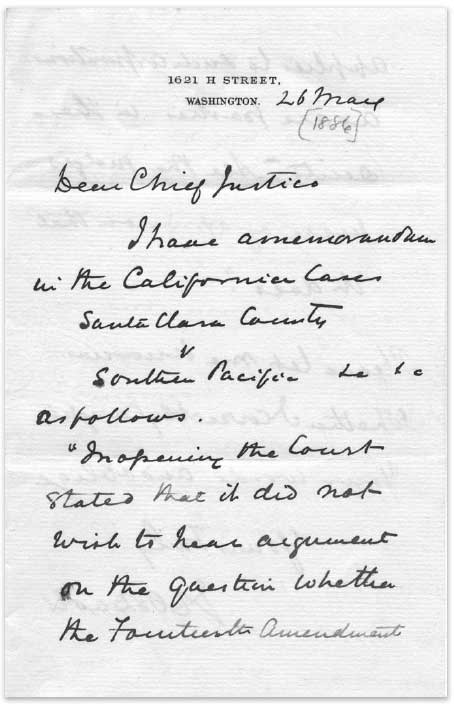
Nevertheless, the decision-making process was deeply flawed. Up until that time, there had been no ruling formally accepting that corporations would retain Fourteenth Amendment rights. Thus, when Supreme Court Chief Justice Morrison Remick Waite announced orally, (before the arguments were ever even presented) that the Court then unanimously conceded corporations to be persons within the meaning of the Equal Protection Clause, his remark had no legal basis.
The court does not wish to hear argument on the question whether the provision in the Fourteenth Amendment to the Constitution, which forbids a State to deny to any person within its jurisdiction the equal protection of the laws, applies to these corporations. We are all of the opinion that it does.

That’s it. That’s where corporate personhood began.


The matter was apparently never openly discussed. Neither side of the issue was weighed nor fairly represented. It might well have been decided by a toss of a coin for all we know. This crucial point- upon which the whole personhood debate rests- is all merely a matter of a private, undocumented agreement between judges. We must accept, then, that the matter was discussed privately among the justices but there is no record of it.
As Thom Hartmann uncovered in his book, Unequal Protection: The Rise of corporate Dominance and Theft of Human Rights, the task of giving a summary of the decision for the headnotes for the case fell to a man named John Chandler Bancroft Davis. He was no doubt confused about one fine point that had to be included in the headnote.

As Wikipedia informs us:
Preceding every case entry is a headnote, a short summary in which a court reporter summarizes the opinion as well as outlining the main facts and arguments. For example, in United States v. Detroit Timber Lumber Company (1906), headnotes are defined as "not the work of the Court, but are simply the work of the Reporter, giving his understanding of the decision, prepared for the convenience of the profession.
Bancroft Davis asked the Chief justice for clarification from the leader of the court,
"Please let me know whether I correctly caught your words and oblige."
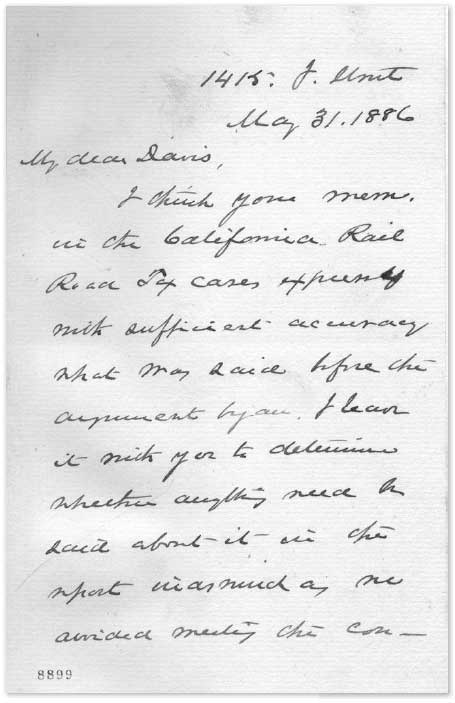
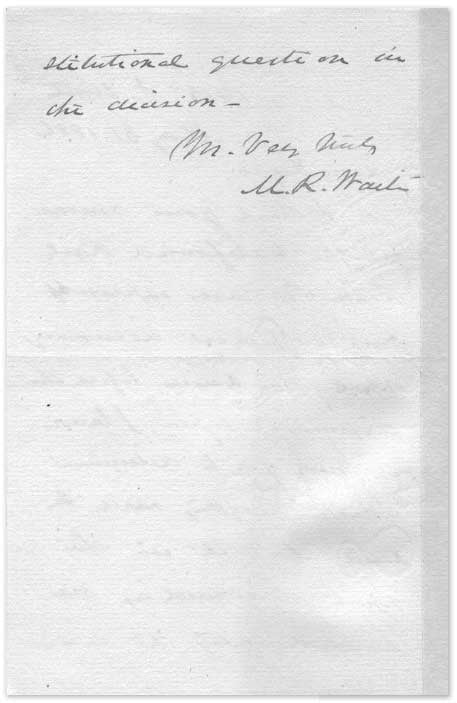
The reply was as remarkable as it was brief. Justice Waite responds:
"I think your mem. in the California Rail Road tax cases expresses with sufficient accuracy what was said before the arguments began. I leave it with you to determine whether anything need be said about it in the report inasmuch as we avoided meeting the Constitutional question in the decision."[emphasis mine]
Thus the matter of corporate personhood left up to the discretion of a minor court reporter writing a summary headnote for a rather unremarkable case.
Later would come other cases to support what corporate lawyers took to be a precedent. Minneapolis & St. Louis Railroad Co. v. Beckwith (1889) Supreme Court ruled a corporation is a “person” for both due process and equal protection, for example, and Noble v. Union River Logging R. Co. (1893) corporations. for the first time, had claim to the Bill of Rights. The 5th Amendment says: “. . . nor be deprived of life, liberty, or property, without due process of law.”And these cases, apparently, like Citizens United, were all based on a non-existent precedent, only referenced in a brief summary by a Court reporter.

Reactions and Objections
One obvious question is whether Chief Justice Waite’s statement whether it actually was unanimously agreed among the other judges that corporations were considered- according to the Fourteenth Amendment- “persons.” There’s no record of it except for the mention of it in the memo. The text of the decision, itself, refers only the corporations have similar rights as citizens in the matter at hand, property tax law, not in a civil context. It reads:
That the provisions of the constitution and laws of California, in respect to the assessment for taxation of the property of railway corporations operating railroads in more than one county, are in violation of the fourteenth amendment of the constitution, in so far as they require the assessment of their property at its full money value, without making deduction, as in the case of railroads operated in one county, and of other corporations, and of natural persons, for the value of the mortgages covering the property assessed; thus imposing upon the defendant unequal burdens, and to that extent denying to it the equal protection of the laws. [emphasis mine]
Another-perhaps more obvious- point:

If the Reconstruction committee (which had originally drafted the amendment) had wished to include the word "corporations" in their amendment, there was nothing obstructing them from doing so. Such divination might be perfectly acceptable for readings of the ancient texts like the Bible, or in documents that pre-dated the context, like the Constitution, but in this case, all of the members of the committee were familiar with corporations. And yet they did not see fit to mention them while composing the draft. So, there is really no valid reason for attempting to read other meanings into the choice of words, and no need for later re-interpretation.

In fact, as Graham pointed out, John A. Bingham, principle framer, employed these guarantees specifically and in a context which suggested that free Negroes and mulattoes (rather than corporations and business enterprise) unquestionably were the persons' to which he then referred. Whatever the lawyers for the railroad companies might have argued, there is no evidence to support their views.

If one wishes to pick at the amendment and attempt to divine secret messages in the text unnecessarily, it can easily work in the opposite direction. As the amendment states that "All persons born or naturalized.." and that opening definitely calls into question whether corporations were ever intended to be included since corporations are neither born nor naturalized, but chartered and founded. They are, after all, man-made creations made by individuals with individual civil rights. Corporations are not born any more than a foundation or a workers' union is born.

Would Republicans, like Mitt Romney, be willing to argue to a snickering crowd that other human-formed organizations are people.. like unions? The Miner's Union is a person? The Teamsters Union is person? 
So was this a case of conspiracy or merely an failure of the court? The whole matter of leaving a court reporter’s note as the only record of such an important issue seems highly suspicious.

The first direct charge of a conspiracy came in 1927 by historians Charles and Mary Beard in The Rise of the American Civilization. They proposed that, back in 1866, the certain members of the Joint Congressional Committee which drafted the Fourteenth Amendment, namely Ohio Congressman John A. Bingham, had conspired on behalf of corporations and with the careful use of terms has widened the scope well beyond its intended purpose. The evidence is not all that convincing; it is a charge which would certainly involve some impressive long term planning.


Still, it’s worth a closer look. The same people who demanded the harshest possible terms for the South, The Radical Republicans, were in control of the Commission that drafted the amendment. This faction, at least by the records available to us, seem to have been motivated by the highest ideals of abolishing slavery. Thaddeus Stevens, leader of the faction, had defended and supported cases involving various minorities, Native Americans, blacks and women. His out-spoken stand against slavery was well-known to all who knew him. His desire for the emancipation of the slaves, the desire to abolish slavery as a institution in the United Sates was genuine. The history of this movement began some thirty years before as ethical, moral and religious argument.

There is not enough evidence to indicate a conspiracy among the drafters of the amendment, as far as I can detect.

Of course, had they desired to assist corporations, they could easily have been more direct about it. The ambiguity of the amendment might merely represent a method of reaching a majority, conclusive decision or approval by Congress. To the Beard conspiracy theory, I will, therefore, apply the Scottish verdict: Neither Guilty or Innocent, Unproven. There’s no argument that the Fourteenth Amendment- no matter how it might have been abused later- is a noble document.


Not every Supreme Court Justice was so easily convinced that corporation deserves to be considered “persons,” with constitutional citizen rights. For example, Justice Hugo Black, former Alabama senator turned Supreme Court Judge did not mince words about his feelings on this interpretation of the Constitution.
I do not believe the word 'person' in the Fourteenth Amendment includes corporations... This Court has many times changed its interpretations of the Constitution when the conclusion was reached that an improper construction had been adopted...When a statute is declared by this Court to be unconstitutional, the decision until reversed stands as a barrier against the adoption of similar legislation. A constitutional interpretation that is wrong should not stand. I believe this Court should now overrule previous decisions which interpreted the Fourteenth Amendment to include corporations.
Neither the history nor the language of the Fourteenth Amendment justifies the belief that corporations are included within its protection.

...Certainly, when the Fourteenth Amendment was submitted for approval, the people were not told that the states of the South were to be denied their normal relationship with the Federal Government unless they ratified an amendment granting new and revolutionary rights to corporations.
As Justice Sotomayor has correctly observed, the decision, which has formed the basis for over a century of corporate law, is questionable, to say the least, being based merely on an answer to a court reporter's summary, on false testimony from an unreliable witness and on contestable court procedure.

The fact that so many other later decisions regarding corporate personhood were based on this decision presents something of a nightmare for the courts.
For example, as author, William Meyers points out,

Corporate personhood is at the root of such Supreme Court rulings as First National Bank of Boston v. Bellotti [435 U.S. 765 (1978)], which equate corporate donations to political campaigns with free speech. They allow corporate money to govern the political process. These rulings can be reversed once the 1886 decision is reversed, since they are directly dependent upon it. Then we should be able to force corporations out of the political process. We could do this through legislation or through the chartering process. Without personhood the corporations are not entitled to First Amendment rights; they will have only what privileges the people, through our government, give them.

We can and should prohibit them from making any kind of contribution to politicians, to lobbying groups, or to campaigns involving referenda. Any advertising that does not sell products — that is, any advertising not presenting factual information about the products or services a corporation offers — should be prohibited.

Decision after decision would have to be revisited but, by repealing corporate personhood it would also allow the government to return to its proper place as protector of living citizens and not the slave of artificial persons.

Just because the same mistake is repeated over and over, it doesn't make it any less wrong. Look where it has led our country, after all. This is an issue that will not go away. It has brought millions out into the streets to protest and millions more will follow them if some kind of just and impartial review of the issue is ignored. This matter threatens to ruin the nation. We have become the very empire our own founding fathers fought and died in an effort to repulse.

I think this will soon become one of the most important issues of our time, given the national or should I say, international revolt against corporate encroachments, against the widespread thoughtless destruction of the environment and against the victimization of weaker but resource-rich nations, including our own, for the sake greater profits for our corporate slave masters.

---------------------------------------

If you’d like more detailed information about this subject, I invite you to read Unequal Protection: The Rise of Corporate Dominance and Theft of Human rights,” by Thom Hartmann.

Addition information can be found (full text) at The Santa Clara Blues: Corporate Personhood versus Democracy, by William Meyers.
Here's a important (and entertaining) documentary. If you have not yet watched it, I'd highly recommend it.